
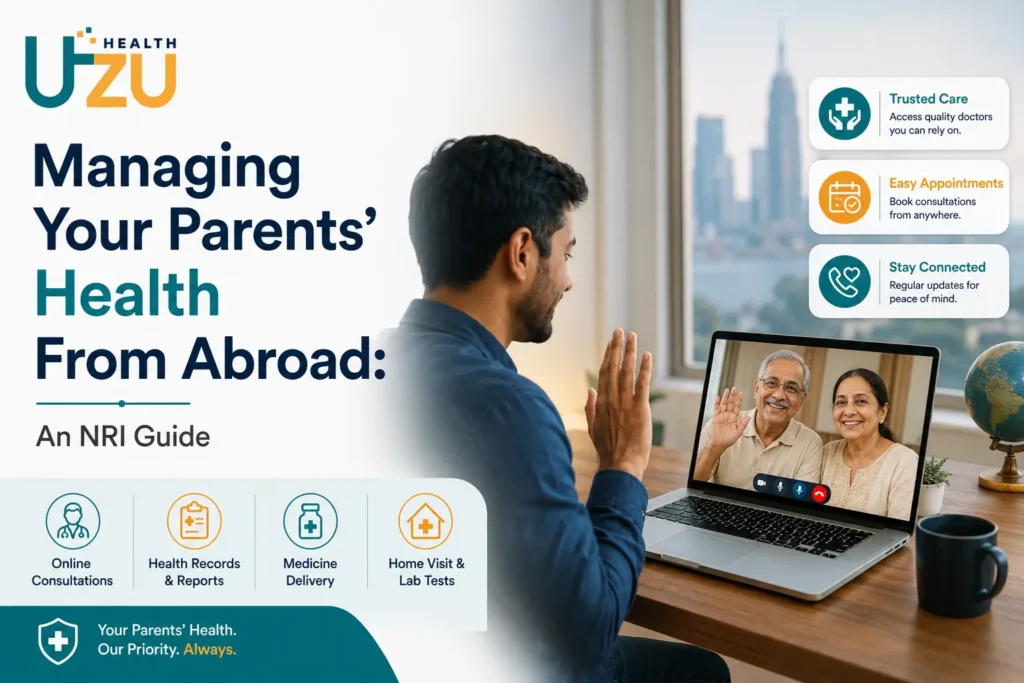
Managing your parents’ health from abroad starts with an honest audit. Answer these four questions, only to yourself.
When did your mother last tell you she was unwell, before she was already better?
Do you know the name of the tablet your father takes every morning, and what it is for?
If something happened at two in the afternoon in Guwahati today, the middle of your working day, who is the first person you would call?
And when you last asked “how is your health,” did you actually get an answer, or did you get “everything is fine, you do not worry”?
Most of us cannot answer all four. That is not a failure of love. It is the arithmetic of distance, and almost every Indian living abroad is doing the same difficult sum.
The short answer on managing your parents’ health from abroad: it works when you build three things in advance. One trusted local contact who can act without waiting for your instructions, a habit of regular check-ins rather than waiting for a crisis, and a clear plan for what happens in a genuine emergency. Set those up while things are calm and distance stops being what keeps you awake.
This guide covers the whole picture: the worries nobody names out loud, what actually goes wrong, and what practically closes the gap.
Why is managing your parents’ health from abroad such a common struggle?
According to the Ministry of External Affairs, the Indian diaspora numbers roughly 35.4 million people worldwide, of whom around 15.85 million are non-resident Indians. Behind a large share of those numbers sits a parent, or a pair of parents, still in India.
The scale of that separation is measurable. Studies drawing on India’s two major ageing surveys estimate that between36% and 43% of older Indians have at least one migrant child, meaning a very large share of the country’s elderly population is being cared for, in some form, from a distance.
And the distance has a cost that is not only emotional. A 2024 study published in Archives of Public Health, analysing data from more than 5,000 older adults, found a clear health gap between those left behind by migrant children and those who were not:
| Factors | Left behind by a migrant child | Not left behind |
| Report poor health | 20% | 13% |
| Show depressive symptoms | 17% | 12% |
A separate peer-reviewed study in BMC Public Health, examining 4,736 older parents left behind by migrant children, found the burden falls unevenly by gender.
Depression was higher among mothers than fathers, and difficulty with everyday activities such as shopping, managing money, or getting around was reported by 54% of mothers compared with 34% of fathers.
Read that last finding again, because it is the one most people miss. The health effect of your absence is not only about who takes them to the doctor. It is about the quiet weight of managing alone, and it lands hardest on mothers.
The worries nobody says out loud.
Ask any Indian living abroad what keeps them up, and you will get a version of the same list. Here it is:
| The worry | What it actually sounds like |
| The information worry | They will not tell me anything until it is serious. |
| The 2 am worry | If the phone rings at an odd hour, my stomach drops before I even look. |
| The imposition worry | How many times can I ask the neighbour to take them to the hospital? |
| The quality worry | How do I know that doctor was any good? I was not in the room. |
| The decision worry | They are describing symptoms on the phone, and am I supposed to decide what happens next? I am not a doctor. |
| The guilt worry | Everyone else’s children live twenty minutes away. |
| The timing worry | By the time I find out, it has already been two days. |
| The future worry | What happens when they genuinely cannot manage alone anymore? |
None of these are irrational. Each one has a practical answer, which is the point of the rest of this guide.
What actually goes wrong, and why?
- You cannot act on instinct: If you lived nearby, you would simply notice your mother seems slower this month and take her in. From abroad, you are relying entirely on what she chooses to tell you. And elderly parents very often downplay symptoms specifically so as not to worry a child who is far away. It is rarely dishonesty. It is love, pride, or habit, wearing the same three words: “I am fine.”
- Time zones convert every concern into a delay: A worry that surfaces at your parent’s nine in the morning is often your eleven at night. Either you are permanently interrupted, or you learn about things hours after the fact, when the useful window for a quick decision has already closed.
- Nobody is coordinating anything: Appointments, medication refills, test results, follow-ups, remembering which doctor said what. Without a dedicated point of contact, all of it falls on your parent alone, or gets scattered across relatives and neighbours who may not always be available and who you feel guilty asking repeatedly.
- Emergencies are the worst version of all three at once: A fall, a chest pain episode, a sudden high fever. You are finding out secondhand, unable to instruct anyone, entirely dependent on whoever happens to be nearby making the right call.
The gap between what you would do and what you can do
| If you were there, you would | From abroad, most people can only | What closes the gap |
| Notice they seem unwell before they say anything | Wait for them to mention it | Scheduled check-ins, so problems surface on a timetable rather than a confession |
| Drive them to the doctor yourself | Ask a relative or neighbour, again | A service that arranges the visit without needing a family member to escort |
| Sit in the consultation and ask your own questions | Get a summarised version afterwards | Joining the consultation remotely, on video, from your own time zone |
| Judge whether the doctor was thorough | Take your parent’s word for it | A written record of the consultation and its findings, shared with you |
| Check whether the medicines are actually being taken | Assume they are | A home visit where the doctor sees the medicines in the house |
| Decide quickly when something changes | Wait until you are awake to respond | A local contact authorised to act immediately |
Managing your parents’ health from abroad: the practical framework
1. One trusted local point of contact
This is the piece that changes everything else, because every other problem on this page reduces to the same root cause: there is no one whose job it is to hold the whole picture.
A Health Counselor does exactly that. Rather than your parents, or you from abroad, working out which doctor to call, the Counselor already holds the context: the conditions, the medications, the history, what happened last time. They arrange the right care and update you afterwards. One relationship, rather than a scattered list of contacts you are managing under pressure at two in the morning.
2. Regular check-ins that do not wait for a crisis
Most families abroad engage with healthcare reactively. Something goes wrong, then everyone scrambles. Scheduling regular consultations for ongoing conditions changes the pattern entirely, because problems surface early rather than after they have escalated.
A quarterly review of blood pressure, diabetes, or general wellbeing takes twenty minutes. And crucially, you can be on the call too, from wherever you are.
Read More:Online Doctor Consultation in Guwahati: How Uzuhealth Is Changing Local Healthcare
3. A home visit option for anything a call cannot assess
Some things genuinely need a doctor physically present. Vitals checked, a proper examination, a hands-on assessment when a parent insists they are fine but you are not convinced. Being able to arrange a home visit remotely, without a relative having to organise it personally, removes one of the largest sources of stress in caring from a distance.
Read More: How to Book a Home Visit Doctor in Guwahati — and What to Expect
4. Clarity on which situation needs which response
Not every worry is an emergency, and not every emergency needs the same response. Having that mapped out before something happens, rather than during, is what turns panic into a clear next step.
Online consultation or home visit: which one for which situation
For families abroad, this is the decision that comes up most often. Here is what you need:
| Your parent’s situation | Better option | Why |
| Routine review of BP, diabetes or thyroid | Online consultation | No travel needed, and you can join the call |
| Prescription running out | Online consultation | A review and renewal takes minutes |
| “I am fine” but you are not convinced | Home visit | A doctor in the room sees what a camera cannot |
| Fever, cough, or stomach upset in early days | Online consultation | Assessed by symptoms; a test can be ordered if needed |
| Parent is weak, unsteady, or recovering from surgery | Home visit | Physical examination and vitals are essential |
| Parent is uncomfortable with phones or video | Home visit | Removes the technology barrier entirely |
| Second opinion on a diagnosis | Online consultation | Reports can be shared digitally, and you can be present |
| Something changed, and nobody can describe it clearly | Home visit | In-person observation catches subtleties |
Read More: Home Visit vs Online Consultation: Which One Does Your Situation Need?
Why do online consultations work especially well for families abroad?
Beyond convenience, some advantages matter specifically when you are the one living overseas.
- You can be in the room again: Joining the consultation on video means you hear the doctor’s assessment directly, in their words, rather than a summary filtered through a parent who may soften it. You can ask your own questions.
- Time zones stop being a barrier: Consultations can be scheduled at a time that works for both your parent’s morning and your evening.
- Nothing depends on someone being free to escort them: No asking a neighbour. No waiting for a cousin’s day off.
- Your parent is not exhausted before the consultation even begins: For an elderly patient, the journey and the queue are often harder than the illness.
- There is a written record: A digitally signed prescription and a documented consultation mean you are not relying on memory or a half-remembered phone conversation.
Why home visits matter even more when you live far away?
Doctor home visits solve a problem that no video call can, and it is the exact problem NRI families describe most often.
- The doctor sees what you cannot: Whether the medicines on the shelf have actually been taken. Whether there is a loose rug at the top of the stairs. Whether the kitchen suggests someone is eating properly. This context is invisible on a video call and invisible from another continent, and it materially changes the advice a doctor gives.
- Your parent cannot minimise what a doctor observes directly: “I am managing fine” is harder to maintain when someone is watching how you get up from a chair.
- Nobody has to be inconvenienced: No relative takes a day off. No neighbour is asked for the fifth time.
- Fall risk gets assessed properly: For an elderly parent living alone, this is one of the most consequential things a doctor can evaluate, and it can only be done in the home.
Read More: Why More Guwahati Families Are Choosing Doctor at Home Services
The Health Counselor: someone there when you cannot be
Let us be honest about what this is and is not. No service replaces a son or a daughter. Nobody is claiming that, and you would be right to distrust anyone who did.
But if you look carefully at what a child actually does in these situations, a surprising amount of it is not emotional. It is logistical.
✅Working out which doctor is needed.
✅Making the appointment.
✅Being present so the questions get asked.
✅Understanding what the prescription actually means.
✅Booking the test.
✅Remembering to check a week later whether things improved.
✅Knowing the history so nothing has to be explained from scratch each time.
That is the part a Uzuhealth Health Counselor takes on. Not your place in your parents’ lives, but the running around you would be doing if you were there.
In practice, for a family abroad, it looks like this. You send one message describing what you are worried about.
A Counselor calls your parents, understands the situation properly, and decides with you whether this needs a consultation, a home visit, or a hospital visit. They arrange it. They make sure the doctor knows the history before the appointment starts. Afterwards, they explain what was found, in plain language, to your parents and to you. They arrange any tests. And they follow up to check whether things actually improved, rather than leaving that to a parent who will tell you everything is fine regardless.
For your parents, it means a familiar person who knows their case, rather than starting again with a stranger every time. For you, it means the phone call at two in the morning is a great deal less likely, because someone was already watching.
| A checklist to set up before you need it Do these while things are calm, not during a crisis: One trusted local contact who knows your parents’ medical history and can be reached quickly. A written record of current medications, conditions, and known allergies, shared with that contact. Recent test reports gathered in one place, ideally digitally, so nothing has to be hunted for. A standing plan for routine check-ups, not only reactive visits when something feels wrong. A way to join consultations remotely, even from a different time zone. Clarity on what counts as an emergency for your parents’ specific conditions, and what the immediate next step should be. One honest conversation with your parents about telling you things earlier rather than after they resolve. |
Managing your parents’ health from abroad when they live in Guwahati
For families with parents in Guwahati or elsewhere in Assam, there is a practical layer worth understanding. Guwahati is the healthcare hub for the entire Northeast, which means its major hospitals absorb patients from across the region and its OPD queues reflect that.
Asking an elderly parent to navigate that alone, or asking a neighbour to accompany them yet again, is a genuine imposition. It is often exactly why parents avoid going at all, and why you find out about a problem later than you should have.
At Uzuhealth, a Health Counselor becomes the single point of contact for your parents’ care in Guwahati. They coordinate online consultations, arrange home visits when a physical examination is needed, and follow up afterwards, with updates that reach you rather than only your parents.
You are not the one juggling appointments, chasing test results, or wondering who to call. Whether it is a routine review of your father’s blood pressure, or same-day care because your mother mentioned she was not feeling well, one message starts the process, and someone stays on it until it is resolved.
Distance does not have to mean disconnection.
Go back to those four questions at the top. The reason most people cannot answer them is not that they care less than they should. It is that nobody built a system, because the day you moved abroad, nobody sat you down and explained that you would need one.
Build it now, while things are calm. One local contact who knows the history. A rhythm of check-ins rather than emergencies. A clear plan for the worst day. Do that, and the guilt that comes with being far away loses most of its grip, because the honest source of that guilt was never the distance. It was the helplessness.
Set up trusted care for your parents in Guwahati before you need it in an emergency.
Frequently Asked Questions
1. How can I manage my parents’ health from abroad?
Set up three things in advance: one trusted local point of contact who can coordinate care without waiting for your instructions, regular remote health check-ins rather than only reacting to problems, and a clear plan for emergencies. A guided service with a Health Counselor can handle this coordination on your behalf.
2. How common is it for NRIs to struggle with elderly parent care in India?
Very common. Research indicates that between 36% and 43% of older Indians have at least one migrant child. A 2024 study in Archives of Public Health found that 20% of those left behind report poor health compared with 13% of those who are not, and 17% show depressive symptoms compared with 12%. With an Indian diaspora of roughly 35.4 million people, this is one of the most widespread and least discussed challenges among families abroad.
3. Can I book a doctor’s appointment for my parents in Guwahati while living abroad?
Yes. Online consultations and home visits can both be arranged remotely, with a Health Counselor coordinating the process and keeping you updated, so you do not need to be physically present or rely on relatives.
4. Should I book an online consultation or a home visit for my parents?
Choose an online consultation for routine reviews, prescription renewals, early-stage common illnesses, and second opinions. Choose a home visit when a physical examination is needed, when your parent is weak or recovering, when they are uncomfortable with technology, or when you suspect they are downplaying how they actually are.
5. Can I join my parents’ doctor consultation remotely?
Yes. Some platforms provide that facility for online consultations and can include family members joining from anywhere, so you can hear the doctor’s assessment directly and ask your own questions rather than relying on a secondhand summary.
6. What should I set up before an emergency happens?
A trusted local contact who knows your parents’ medical history, a written record of their current medications and conditions, recent test reports kept together, and clarity on what qualifies as an emergency for their specific health situation.
7. How do I know if my parents are hiding health problems from me?
Many elderly parents downplay symptoms to avoid worrying children who live far away. Regular scheduled check-ins remove the need for them to raise problems themselves, and a home visit allows a doctor to observe directly what a phone call cannot reveal.
8. How do time zone differences affect managing my parents’ healthcare?
They delay communication and turn minor issues into anxious, hours-long waits. Having a local point of contact authorised to act immediately, rather than waiting for you to wake up, removes most of that pressure.
Disclaimer: This article is for general informational purposes only and is not a substitute for professional medical advice, diagnosis, or treatment. Always consult a qualified healthcare provider for any medical concern.