

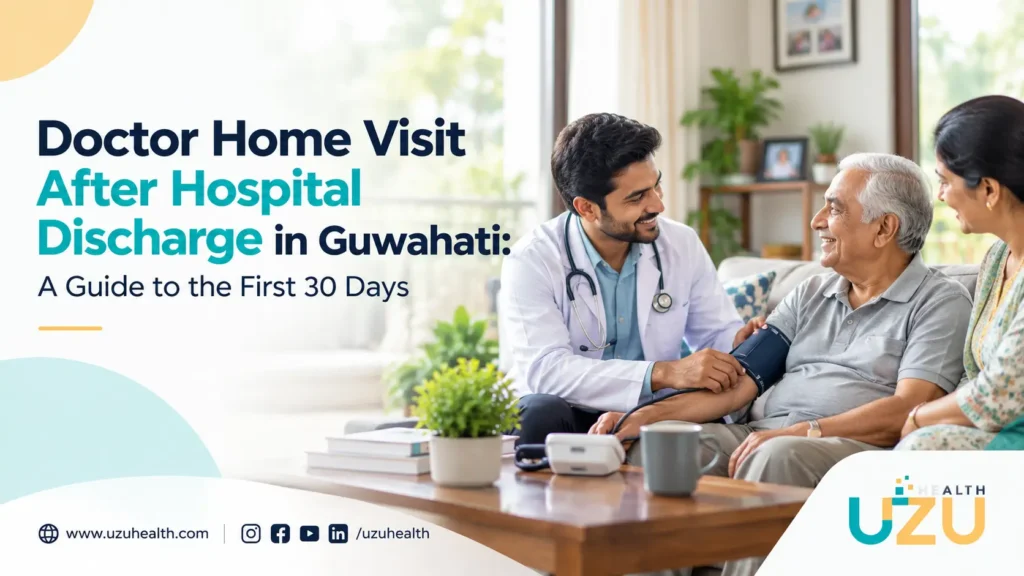
“ঘৰলৈ আহিলেই ভাল লাগিব।“
(Once he’s home, he’ll feel better.)
Everybody says it on the drive back from the hospital, and it is mostly true. Home is better. People sleep, eat properly, and stop being woken at four in the morning for observations.
But a quieter fact lies beneath it, and most families learn it the hard way.
A doctor home visit after hospital discharge exists because most things go wrong in the first few weeks at home, and nobody is watching. Roughly a third of post-operative complications are diagnosed after discharge rather than before it. Most readmissions happen inside the first fortnight. And most follow-up appointments are scheduled for two weeks, by which time a large share of the people who were going to deteriorate already have.
That gap is what this article is about: what actually happens in those thirty days, in what order, and which parts a doctor at home can catch.
Why the first 30 days matter more than people expect?
The hospital stay is the visible part of treatment. The recovery is the longer part, and it happens somewhere nobody is monitoring.
Complications don’t stop at the hospital door. A study of general surgical patients found an overall 30-day complication rate of 31%, with 37% of those complications occurring after discharge. A larger analysis found that one-third of all complications and more than half of all surgical site infections were diagnosed after the patient had gone home , 66% of surgical site infections, in fact.
And they arrive on a schedule. The same research found that wound infections were less common immediately after discharge (26%) and rose sharply beyond 12 days (42%), while gastrointestinal complications clustered early. In other words, the risk doesn’t fade steadily , it shifts in character as the weeks pass.
The timing mismatch is the real problem. One hospital reviewing its own readmissions found that the majority of patients came back within the first 14 days , and noted, pointedly, that most patients did not follow up with their surgeons for two weeks after discharge.
Read that twice. The period of highest risk is the period with the least medical contact.
The Discharge Prescription or Discharge Summary
When you leave the hospital, the discharge summary or prescription is the most dangerous point for medication mix-ups. Most people assume mistakes happen while staying in the hospital, but they actually happen most often when you are heading home.
Breaking Down the Findings
- Discharge is the biggest bottleneck: A study in an Indian hospital tracked medicine lists at three stages: when patients arrived (admission), when they moved between rooms (transfer), and when they went home (discharge). Discharge had by far the most unintended mistakes, averaging 1.37 mix-ups per patient (compared to 0.85 at admission and 0.23 during transfer).
- It’s a global, widespread issue: A review of multiple studies worldwide found that after leaving the hospital:
- Over 50% of patients have an accidental medication mistake or discrepancy on their home list.
- It causes real harm (especially for older adults): Among older, high-risk patients, those who left the hospital with prescription mix-ups were twice as likely to end up back in the Emergency Room within a month.
Why Does This Happen?
When you are discharged, doctors often change doses, drop old medications, or add new ones. If the doctor forgets to list a home medication you still need, writes down the wrong dose, or fails to explain what changed, you end up taking the wrong pills at home.
In Short
Leaving the hospital is when medication mistakes are most likely to happen. Always review your discharge papers carefully, confirm which old pills to stop or keep taking, and double-check your new list with your family doctor or local pharmacist before taking anything.
What this looks like in a real house in Guwahati:
- A regular blood pressure or diabetes medicine was paused during admission, and nobody restarted it.
- The discharge summary lists a generic name; the strip at home has a brand name; the family assumes they’re different and takes both.
- A painkiller was prescribed for five days and is still being taken three weeks later.
- Two prescriptions, one from the surgeon, one from the physician, overlap, and nobody has compared them
- The elderly patient’s regular medicines sit in a different box from the new discharge medicines, and the two have never been looked at together.
Remember that Northeast India already records the country’s highest rate of polypharmacy at 65%, with more older adults taking five or more medicines than any other region. Add a discharge prescription on top of an existing list nobody has reconciled, and the arithmetic gets difficult fast.
A proper medicine review in the week after discharge is the single highest-value thing anyone can do, and it is far easier to do standing in front of the actual boxes.
Read More: Elderly Care in Guwahati: When Should a Doctor Come Home?
The first 30 days, week by week
Recovery is not one undifferentiated stretch. Different things go wrong at different points.
| Period | What typically goes wrong | What should be checked |
| Days 1–3 | Medicine confusion, pain not controlled, nausea or vomiting, not eating or drinking, difficulty passing urine or stool | The full medicine list reconciled against what’s actually in the house; pain relief adequate; fluids and food going in |
| Days 4–7 | Early deterioration, fever, breathing difficulty, constipation from painkillers, falls while unsteady | Vitals, chest, hydration, mobility, home safety |
| Days 8–14 | Peak readmission window. Wound problems start appearing; energy plateaus; chronic conditions destabilise | Wound inspected properly; blood pressure and sugar rechecked; are the chronic medicines back on track |
| Days 15–30 | Wound infection risk is highest here. Function not returning; appetite and weight still down; low mood | Wound again; nutrition; strength and mobility; whether anything needs escalating before the follow-up |
Two practical points fall out of this table.
If you can only arrange one check, put it around day seven to ten. That lands before the readmission peak and before the infection window, where a visit changes the outcome rather than confirming it.
And wound problems arriving in week three are normal, not late. Families often assume a wound that looked fine at discharge is settled. More than half of surgical site infections are diagnosed after the patient goes home, with the risk rising rather than falling as the fortnight passes.
What does a doctor home visit after hospital discharge actually do?
A full consultation, in the place where recovery is actually happening.
| What happens | What it covers |
| Medicine reconciliation | Every box in the house checked against the discharge summary , duplications, omissions, things that should have been restarted, things that should have stopped |
| Vitals | Blood pressure, pulse, temperature, oxygen saturation, blood sugar where relevant |
| Wound and dressing check | The thing most likely to go wrong in weeks two and three |
| Physical examination | Chest, abdomen, swelling in the legs, anything the discharge noted to watch |
| Recovery assessment | Eating, drinking, bowel and bladder function, sleep, pain, mood |
| Mobility and fall risk | How steady they are, and what in the house is a hazard |
| The discharge summary, explained | In plain language, to the people actually providing the care |
| Next steps | Which tests, which follow-ups, and precisely what to watch for |
What it cannot do: scans, procedures, or emergency care. A home visit establishes what is needed and catches problems early. When a hospital is required, it tells you that sooner rather than later , which is the point.
Who needs a doctor home visit after hospital discharge most?
Not everyone needs one. These situations are where it earns its cost.
- Any patient over 65, particularly if they were already on several medicines before admission.
- Surgical discharges with a wound, especially abdominal surgery, orthopaedic procedures, or anything where the dressing needs reviewing.
- Stays of a week or longer, where deconditioning is likely, and the medicine list has probably changed substantially.
- Patients discharged with new medicines added to an existing long list.
- Anyone discharged after an ICU stay, where the medicine changes are usually extensive.
- Patients who live far from the treating hospital , Jorhat, Nagaon, or anywhere a follow-up means a full day of travel for a ten-minute check.
- Families coordinating from another city, where a phone call cannot tell you whether a wound looks right.
- Anyone who left hospital still weak or unsteady, where the trip back for follow-up is itself a risk.
- Patients with diabetes. Wounds heal slower, and infections progress faster.
Warning signs in the first 30 days
Illness after discharge often announces itself quietly. These are the signs families most often wait too long on.
| Warning sign | Why it matters |
| Fever, or feeling generally unwell | The most common first sign of post-discharge infection |
| Wound becoming red, swollen, warm, or more painful | Surgical site infection, risk peaks in weeks two to three |
| Discharge from the wound, especially cloudy or foul-smelling | Needs assessment the same day |
| Sudden confusion in an elderly patient | Often infection, before any fever appears |
| Not eating or drinking for more than a day | Dehydration escalates quickly in a weakened patient |
| Not passing urine, or very little | Needs prompt attention |
| Pain getting worse rather than better after the first few days | The direction matters more than the level |
| Breathlessness, chest pain, or calf pain and swelling | Go to hospital immediately , possible clot or cardiac event |
| Wound opening up, or bleeding | Go to hospital immediately |
On the confusion one: families routinely put sudden disorientation in an older patient down to tiredness or the strangeness of being home. In an elderly person recently discharged, new confusion is an infection until proven otherwise.
When you don’t need a home visit
Being clear about this saves you money, and any service that won’t say it is selling rather than advising.
- A fit younger adult after a minor procedure, recovering normally, with a follow-up already booked.
- A short admission with no medicine changes and no wound.
- Questions about the discharge summary, test results, or whether a symptom matters , an online consultation handles these well and costs considerably less.
- Anything that is actually an emergency. Chest pain, breathlessness, heavy bleeding, a wound that has opened, sudden weakness, or unconsciousness need a hospital now. Do not book a consultation first.
Read More: Home Visit vs Online Consultation: Which One Does Your Situation Need?
Arranging a doctor home visit after hospital discharge
Through Uzuhealth, home visit consultations start at ₹1,500 for locations within 10km and ₹2,000 within 15km, with same-day visits available when needed. Terms and conditions apply.
Working in collaboration with Arya Hospital, one of Guwahati’s most trusted institutions, Uzuhealth has served over 500 families across the city.
Have these ready before the doctor arrives
- The discharge summary, in full. Not the prescription slip alone , the whole document.
- Every medicine in the house in one place. Both the new discharge medicines and everything they were taking before admission. This is the single most valuable thing you can prepare.
- All reports and scans from the admission.
- A note of what has changed since coming home , appetite, sleep, pain, bowel movements, mood, how steady they are walking.
- The date of the hospital follow-up, so the visit can be positioned usefully rather than duplicating it.
If you’re arranging this from another city
This is the common situation now, not the unusual one, and it is where coordination matters more than the consultation.
At Uzuhealth, a Health Counselor speaks with you first, understands what the admission was for, and coordinates the right doctor. Afterwards, the Counselor stays with the case , arranging tests the doctor orders, explaining the findings in plain language, and following up to check recovery is on track.
For a son in Bengaluru or a daughter in Dubai, the honest product isn’t the consultation. It’s someone in Guwahati who has actually looked at the wound and will tell you the truth about it.
Read More: Managing Your Parents’ Health From Abroad: An NRI Guide
The fortnight nobody plans for
Discharge feels like an ending. Clinically, it is a handover , from a ward with nurses, monitors and a doctor on the floor, to a family at home doing their best with a two-page summary.
Most of that handover goes fine. The part that doesn’t goes wrong in the second week, when the hospital follow-up hasn’t happened yet, and nobody has looked at the wound or the medicine box since the day you left.
One visit, placed in that gap, is usually all it takes.
Frequently Asked Questions
1. When should I arrange a doctor home visit after hospital discharge?
Around day seven to ten is usually the most useful single visit. That lands before the peak readmission window and before wound infection risk rises, which is when a check changes the outcome rather than just confirming it. Arrange one sooner if there is fever, worsening pain, a wound problem, or confusion.
2. What does a doctor check at a post-discharge home visit?
Every medicine in the house against the discharge summary, vitals including blood pressure and oxygen saturation, the wound and dressing, a physical examination, recovery markers like eating and bowel function, mobility and fall risk, and a plain-language explanation of the discharge summary for the family.
3. Isn’t the hospital follow-up enough?
Often not, because of timing. Most readmissions happen within the first fortnight, and most hospital follow-ups are scheduled at two weeks. That leaves the highest-risk period with no medical contact at all.
4. Why do medicines get confused after discharge?
Because discharge is the most error-prone point in the whole stay. An Indian tertiary care study found the highest rate of unintentional medication discrepancies at discharge, and systematic reviews put the rate of errors or discrepancies after discharge at around half of patients. Regular medicines get paused and not restarted, brand and generic names get doubled up, and short courses get continued too long.
5. Who benefits most from a doctor home visit after hospital discharge?
Patients over 65, anyone discharged with a surgical wound, stays of a week or longer, patients with diabetes, anyone on several medicines, people living far from the treating hospital, and families coordinating care from another city.
6. How much does a home visit cost in Guwahati?
Through Uzuhealth, home visits start at ₹1,500 within 10km and ₹2,000 within 15km. Terms and conditions apply.
7. My relative’s wound looked fine at discharge. Should I still get it checked?
Yes. More than half of surgical site infections are diagnosed after the patient goes home, and the risk rises rather than falls as the first fortnight passes , wound problems appearing in week two or three are typical, not late.
8. What symptoms mean hospital rather than a doctor home visit after hospital discharge?
Breathlessness, chest pain, heavy bleeding, a wound that has opened, calf pain with swelling, sudden weakness, convulsions, or unconsciousness. These need emergency care immediately , do not book a consultation first.
Disclaimer: This article is for general informational purposes only and is not a substitute for professional medical advice, diagnosis, or treatment. Always consult a qualified healthcare provider for any medical concern.