


Have you started noticing more hair on your pillow, in your comb, or collecting near the shower drain? Perhaps your hair feels thinner, your scalp is becoming more visible, or your hairline looks different from a few months ago.
If you are looking for hair fall treatment in Guwahati, understanding the cause of your hair loss is an important first step. While some daily hair shedding is completely natural, persistent hair fall or noticeable thinning may require medical attention.
According to the American Academy of Dermatology (AAD), most people shed approximately 50–100 strands of hair every day as part of the normal hair-growth cycle.
However, when hair shedding increases unexpectedly, continues for several months, or leads to visible thinning, it may be time to consult a dermatologist in Guwahati.
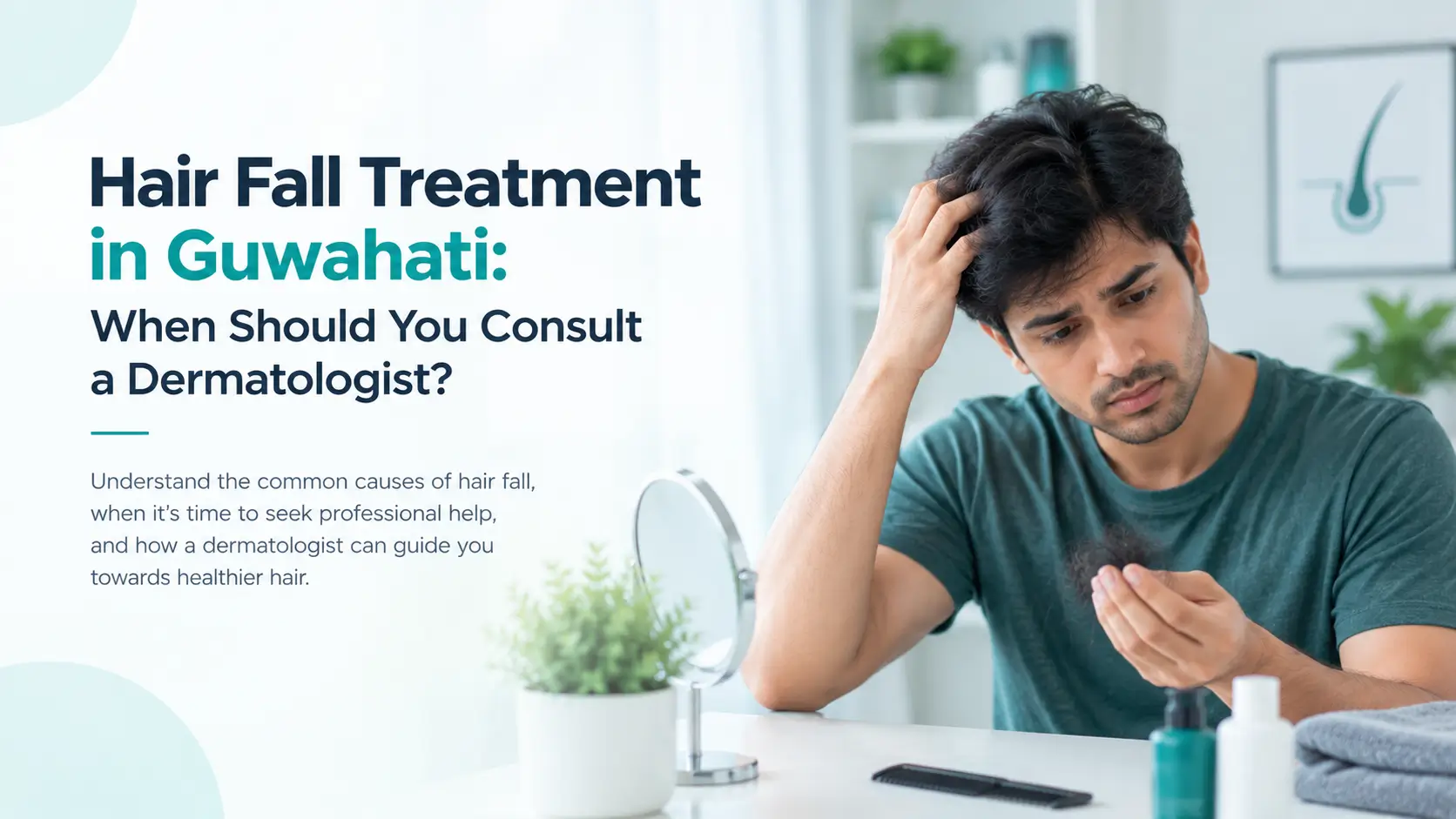
Hair fall can result from several factors, including genetics, physical or emotional stress, nutritional deficiencies, hormonal changes, certain medications, and scalp conditions. Since each cause may require a different approach, identifying the underlying problem is more useful than repeatedly changing hair oils, shampoos, or supplements.
If you are unsure which doctor to consult, UzuHealth can help you begin with a guided online consultation. A Health Counsellor listens to your concerns, helps identify an appropriate doctor, and supports you through the next steps.
Is Your Hair Fall Normal, or Should You Consult a Dermatologist in Guwahati?
Finding loose strands while washing, brushing, or styling your hair does not necessarily indicate a medical problem.
Your hair is continuously growing, resting, and shedding. Once a strand completes its natural cycle, it falls out and another may grow from the follicle.
Understanding the Hair-Growth Cycle
Hair follicles pass through different stages, and not every strand is in the same phase simultaneously.
According to Cleveland Clinic, approximately 85–90% of scalp hair is normally in the active growth phase at a given time.
| Hair-growth stage | What happens |
| Anagen (growth) | Hair actively grows, often over several years. |
| Catagen (transition) | Growth slows and the follicle begins changing. |
| Telogen (resting) | Hair remains in a resting stage before shedding. |
| Exogen (shedding) | The old strand is released as part of normal renewal. |
Because these stages happen at different times, losing some strands every day is expected. The concern begins when shedding increases beyond your usual pattern or when new hair growth does not adequately replace the hair being lost.
Normal Hair Shedding vs Hair Loss That Needs Attention
| What you notice | Possible explanation | Recommended action |
| A few strands during brushing or washing | Normal daily shedding | Monitor your usual pattern |
| Around 50–100 strands daily | Often within the normal shedding range | No need to count every strand |
| Sudden increase in hair shedding | Possible excessive shedding | Consider professional advice |
| A gradually widening centre part | Possible progressive hair thinning | Consult a dermatologist |
| Hairline moving backwards | Possible pattern hair loss | Seek a hair and scalp assessment |
| Circular or irregular bald patches | Possible underlying hair-loss condition | Arrange a dermatologist consultation |
| Hair repeatedly falling out in clumps | Significant change from normal shedding | Seek medical evaluation |
| Hair fall with scalp redness, itching or scaling | Possible scalp condition | Consult a qualified doctor |
The important question is not simply how many strands you lose in one day. It is whether your hair density, shedding pattern, or scalp health has noticeably changed over time.
When Should You Consult a Dermatologist in Guwahati for Hair Fall?
You do not need to develop extensive baldness before getting medical advice.
Some hair-loss conditions progress slowly, making the early changes easy to overlook. Others appear suddenly after a major illness, stressful period, or another health-related event.
The AAD explains that identifying the cause early can improve the chances of managing certain types of hair loss successfully.
Here are the signs that suggest a dermatologist evaluation may be helpful.
1. Your Hair Fall Has Suddenly Increased
Finding significantly more hair than usual on your pillow, clothing, hairbrush, or bathroom floor can be concerning, particularly when the change happens over a short period.
Sometimes, excessive hair shedding occurs after the body experiences physical or emotional stress.
Common triggers include:
- High fever or severe illness
- Major surgery
- Childbirth
- Significant emotional stress
- Rapid weight loss
- Certain medicines or changes in health
One possible explanation is telogen effluvium, a condition in which more hair follicles than usual enter the resting phase, leading to increased shedding later.
The AAD notes that this type of shedding often becomes noticeable a few months after the triggering event
Research insight: The AAD reports that studies have found temporary hair shedding in approximately 20% of people following COVID-19. This illustrates how illness can sometimes affect the hair-growth cycle, although it does not mean every case of shedding after an illness has the same cause.
2. Your Hair Is Gradually Becoming Thinner
Not all hair loss begins with noticeable clumps of hair falling out.
For some people, the changes happen gradually over several months or even years.
You might notice that:
- Your centre part looks wider.
- Your scalp becomes more visible under bright light.
- Your ponytail feels less dense.
- Hair around the crown appears thinner.
- Your hairline is slowly receding.
These changes may be associated with progressive forms of hair loss, including hereditary pattern hair loss.
Research insight: Cleveland Clinic reports that approximately two-thirds of men notice some degree of hair loss by age 35, and around half experience significant thinning by age 50. These estimates are not specific to Guwahati or the Indian population.
Hair thinning can affect women as well, often appearing as a widening part or reduced hair volume.
If you are searching for a hair specialist in Guwahati because your hair density is decreasing, a dermatologist is the appropriate medical specialist to evaluate conditions affecting the scalp and hair follicles.
3. You Notice Bald Patches on Your Scalp
A clearly defined bald patch is different from ordinary daily shedding.
Such patches may appear suddenly or develop over time. Some are smooth and circular, while others may have associated redness, scaling, or broken hair.
Possible causes include alopecia areata and certain infectious or inflammatory scalp conditions.
Alopecia areata is an autoimmune condition in which the immune system affects hair follicles, sometimes producing round or oval areas of hair loss.
In India, studies show that out of all the patients who visit a skin clinic for the first time, about 1 to 2 in every 100 people are diagnosed with alopecia areata.
However, a bald patch does not automatically mean you have alopecia areata.
A dermatologist needs to examine the affected area, surrounding hair, and scalp condition before identifying the cause.
4. Hair Fall Is Accompanied by Persistent Dandruff or Scalp Symptoms
Sometimes, the problem is not limited to the hair strands themselves.
Changes in scalp health may occur alongside hair fall or indicate a separate condition requiring treatment.
If your scalp is painful, swollen, or has sores with discharge, seek prompt medical assessment rather than relying on home remedies.
5. Your Hair Fall Continues for Several Months
Hair shedding after a temporary illness or stressful event may gradually improve once the body recovers.
However, if hair fall continues month after month or your overall hair density keeps reducing, an underlying factor may need investigation.
Potential contributors include hereditary hair loss, ongoing stress, iron deficiency, inadequate nutrition, hormonal or thyroid-related conditions, scalp disorders, certain medications, and repeated tension from tight hairstyles.
Common Causes of Hair Fall: What a Dermatologist in Guwahati May Look For
Hair fall is not one single medical condition. It is a symptom that can develop for different reasons, sometimes involving more than one factor.
Understanding the possible causes can help you recognize why professional evaluation matters.
| Possible cause | Signs you may notice | Why medical evaluation helps |
| Hereditary hair loss | Gradual thinning, widening part or receding hairline | Helps identify pattern hair loss and suitable management |
| Stress-related shedding | Increased shedding a few months after stress or illness | Helps distinguish temporary shedding from other conditions |
| Scalp disorders | Dandruff, redness, itching or scaling | Identifies whether an inflammatory or infectious condition needs treatment |
| Nutritional deficiencies | Hair fall, sometimes alongside fatigue or weakness | Helps determine whether relevant investigations are required |
| Hormonal changes | Hair thinning with other hormonal symptoms | May indicate a need for additional medical assessment |
| Tight hairstyles | Hair loss around frequently pulled areas | Helps identify possible traction-related hair loss |
| Medication-related changes | Hair shedding after starting particular medicines | Allows a doctor to review possible medication effects |
These symptoms do not confirm a diagnosis.
A dermatologist considers your medical history, hair-loss pattern, and scalp condition before recommending appropriate investigations or treatment.
Why Identifying the Cause Matters More Than Buying Hair Fall Products
When hair begins thinning, searching for a quick solution often feels like the easiest first step.
You might purchase an expensive shampoo, switch to a different hair oil, try a scalp serum, or begin taking hair-growth supplements recommended on social media.
If the product doesn’t work after a few weeks, another one may seem worth trying.
But the difficulty is that hair loss does not have one universal cause or treatment.
A product intended for one condition may do little for another.
Cleveland Clinic reported in August 2026 that evidence does not support routine biotin supplementation for improving hair growth in people who are not biotin deficient.
This does not mean every hair-care product or supplement is ineffective. Before spending repeatedly on products or cosmetic treatments, consider discussing persistent hair fall with a qualified dermatologist in Guwahati
What Happens During a Dermatologist Consultation for Hair Fall?
A dermatologist consultation involves more than estimating the number of strands you lose every day.
The doctor generally begins by understanding when the problem started, how it has changed, and whether other symptoms are present.
Questions a Dermatologist May Ask
Your doctor may ask about your recent health, lifestyle, and family history, including:
- When did you first notice increased hair fall?
- Did the shedding begin suddenly or gradually?
- Have you recently experienced fever, illness, surgery, or emotional stress?
- Have you experienced significant weight loss or changed your diet?
- Does anyone in your family have similar hair thinning?
- Are you experiencing scalp itching, dandruff, or discomfort?
- Have you started taking any new medicines?
- Are you experiencing fatigue, weakness, or other health changes?
These details can help the doctor identify possible triggers.
What Does a Dermatologist Examine?
Depending on your symptoms, the doctor may assess your scalp, hair density, areas of thinning, individual hair strands, and the overall pattern of hair loss.
The dermatologist may also examine your skin or nails when relevant.
Dermatologist in Guwahati or General Physician: Which Doctor Should You Choose?
Many people experiencing hair fall are unsure whether to book a dermatologist or start with a general physician.
Both can be helpful, depending on the symptoms.
| Consult a dermatologist for | A general physician may also help with |
| Gradually increasing hair thinning | Hair fall accompanied by persistent fatigue |
| A receding hairline | Unexplained weight changes |
| Bald patches | Hair shedding following a major illness |
| Persistent dandruff with hair loss | Symptoms that may suggest anaemia |
| Scalp redness, scaling or itching | Broader health concerns alongside hair fall |
| Unexplained excessive shedding | Initial assessment of possible systemic causes |
| Hair fall continuing for months | Evaluation of associated medical conditions |
A general physician can also be an appropriate starting point when hair fall occurs alongside other health concerns.
If you are unsure which specialist is right for you, UzuHealth offers a guided consultation process. Through UzuHealth, a Health Counsellor listens to your concern and helps you connect with a suitable doctor. The platform offers access to NMC or State Medical Council-verified doctors.
You can learn more through UzuHealth’s online doctor consultation service.
Can I Consult a Dermatologist in Guwahati Online for Hair Fall?
For many non-emergency hair and scalp concerns, an online consultation may be a convenient first step. This can be especially useful if you want medical guidance before deciding whether an in-person appointment is necessary.
Consider an online consultation if you are experiencing increased shedding, gradual thinning, visible changes in your hairline, or recurring scalp concerns.
You can also prepare photographs showing how your hair has changed, previous medical reports, and a list of medicines or supplements you are taking.
During the consultation, a dermatologist may review your symptoms, health history, and any visible changes that can be assessed over video.
However, online consultation does not replace every physical examination.
Some conditions require a closer scalp assessment, specialised examination, or medical tests. If the dermatologist believes an in-person appointment is necessary, they can recommend the next step.
How UzuHealth Helps You Find the Right Doctor in Guwahati
If you’re experiencing hair fall, you may not always know whether to consult a dermatologist or start with a general physician. And even after deciding, figuring out the next steps can sometimes be confusing.
UzuHealth offers guided consultation support to help make the process easier. A Health Counsellor listens to your concerns and helps you connect with a suitable doctor based on your needs.
Here’s how the process works:
Step 1: Explain Your Concerns
Tell the Health Counsellor what you’ve been experiencing, whether it’s increased hair shedding, gradual thinning, bald patches, or scalp irritation.
Step 2: Find a Suitable Doctor
Based on your concerns, the Health Counsellor can help you identify the appropriate medical specialist, so you’re not left trying to figure everything out on your own.
Step 3: Consult a Doctor Online
When appropriate for your condition, you can consult a doctor online from home. Before your appointment, it may help to keep a few photographs of the affected areas, any relevant medical reports, and a list of medicines or supplements you’re taking.
Step 4: Understand the Next Steps
Depending on the doctor’s assessment, you may be advised to undergo tests, attend a follow-up consultation, or visit a clinic for a physical examination. UzuHealth’s Health Counsellor can help coordinate the next steps.
An online consultation may be a convenient starting point, but some hair and scalp conditions require an in-person examination. Your doctor can advise you on the most appropriate approach.
If you’d like to understand the process better, you can explore UzuHealth’s online doctor consultation service.
Frequently Asked Questions
1. When should I consult a dermatologist in Guwahati for hair fall?
Consider consulting a dermatologist if your hair fall increases suddenly, continues for months, causes noticeable thinning or bald patches, or occurs alongside itching, redness, scaling, or scalp discomfort.
2. Which specialist should I consult for hair fall treatment in Guwahati?
A dermatologist specializes in diagnosing and treating conditions affecting the hair and scalp. A general physician may also help when hair fall is associated with fatigue, weight changes, or other broader medical concerns.
3. Can severe dandruff cause hair fall?
Some inflammatory or infectious scalp conditions can occur alongside hair shedding or hair loss. Persistent dandruff with redness, itching, or scaling should be evaluated by a dermatologist.
4. Can stress cause excessive hair fall?
Yes. Significant physical or emotional stress can sometimes trigger temporary excessive shedding, known as telogen effluvium. Hair fall may become noticeable a few months after the triggering event.
5. Can I consult a dermatologist online in Guwahati?
Yes. Many non-emergency hair and scalp concerns can be discussed during an online consultation. However, your doctor may recommend an in-person examination or further testing when necessary.
Medical Disclaimer: This article provides general educational information and should not replace professional medical advice, diagnosis, or treatment. Consult a qualified healthcare professional for individual medical concerns.



[…] Read more: Hair Fall Treatment in Guwahati: When Should You Consult a Dermatologist? […]