

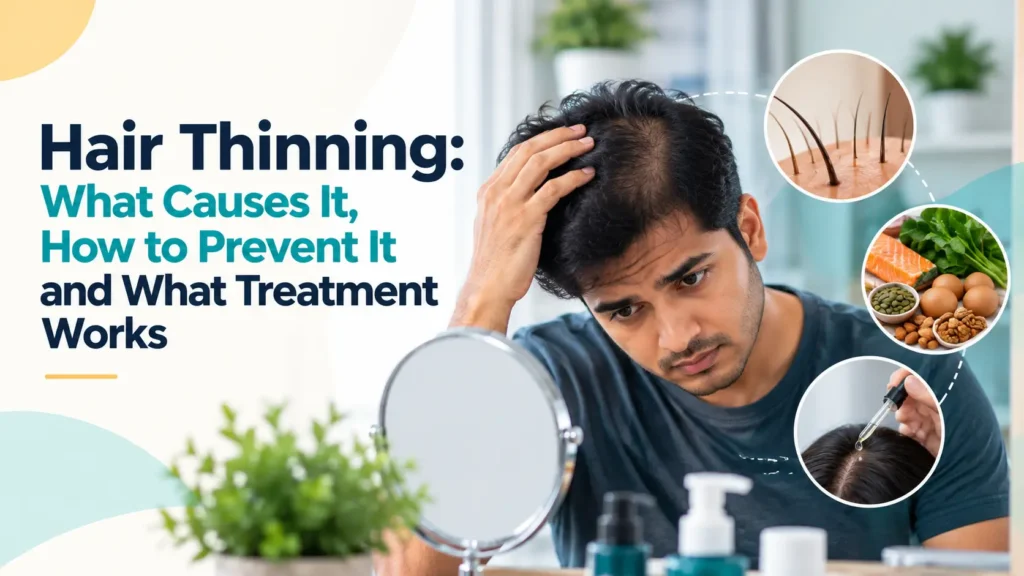
Hair on the pillow, hair in the comb, hair on the bathroom drain, and a sudden worry about how much is coming out.
But hair thinning is the earlier signal, and it is the one almost everybody misses. By the time you are counting strands, the change usually started months or years before, not because more hair was falling, but because the hair growing back was thinner than the hair it replaced.
Shedding is loud and often temporary. Thinning is quiet and usually progressive.
One resolves on its own; the other needs something done about it. And the window where something can be done is widest at the stage when nothing dramatic appears to be happening.
What hair thinning actually is?
Every hair on your head sits in a follicle, and every follicle runs a cycle: a long growing phase lasting years, a short transition, a resting phase, and then the hair is released. Losing 50 to 100 hairs a day is simply that cycle working.
So shedding, by itself, is not the problem. The problem is what grows back.
In pattern hair loss, the follicle/the root undergoes something dermatologists call miniaturisation. With each cycle, the follicle produces a slightly thinner, slightly shorter hair, and spends less time growing it. A thick terminal hair becomes a finer one, then finer again, until eventually it is barely more than the fine vellus hair on a forearm. Medical literature describes this as progressive miniaturisation of the hair follicle leading to vellus transformation of terminal hair.
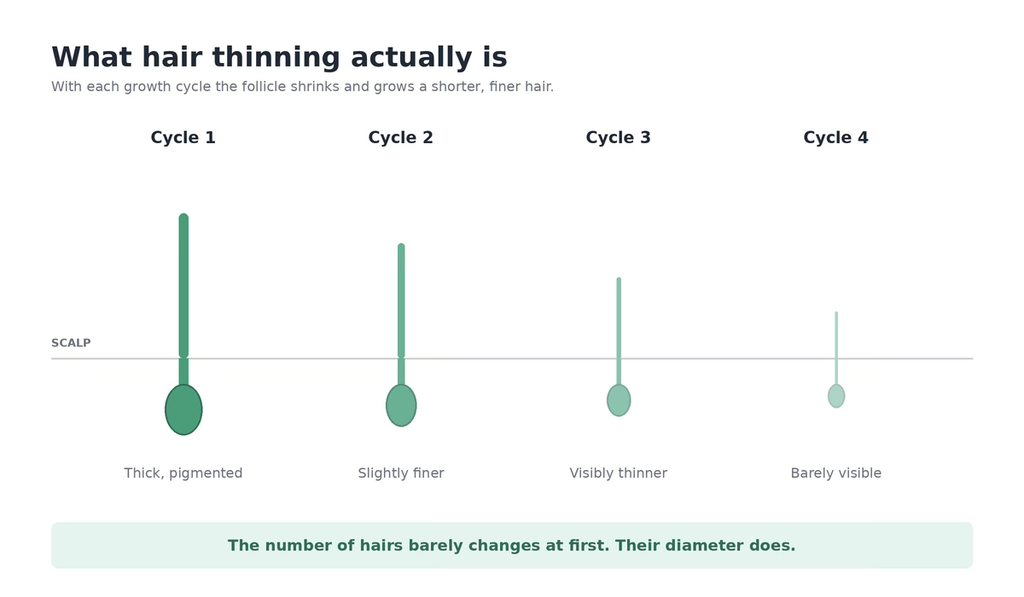
The count of hairs on your head barely changes at first. Their diameter does.
That’s why the early signs are about density rather than loss:
- The parting looks wider than in old photographs.
- The ponytail feels thinner in your hand.
- Scalp shows through under bright light or in a flash photograph.
- Individual hairs feel softer and finer than they used to
- Hair doesn’t hold a style the way it once did
The practical consequence: by the time visible hair fall becomes alarming, a lot of miniaturisation has usually already happened. Follicles that have fully miniaturised are far harder to bring back than follicles only partway there, which is why the unglamorous early stage is the stage that matters.
How common is it?
More common than the silence around it suggests.
A community study of 393 men aged 1850 found a hair fall prevalence of 60.4%, not a clinic sample, but people in their own homes.
For pattern hair loss specifically, Indian studies have found a prevalence of 58% in males aged 30 to 50. Across Asian populations generally, the figure is around 20% of men and 5-6% of women across all ages.
And it is arriving earlier than it used to. Early-onset pattern hair loss, beginning before the age of 30, occurs in roughly 30% of men. For women: thinning tends to be diffuse across the crown with the hairline preserved, and often becomes noticeable around hormonal transitions.
What causes hair thinning?
Thinning is a symptom, not a diagnosis, and more than one cause is often running at the same time.
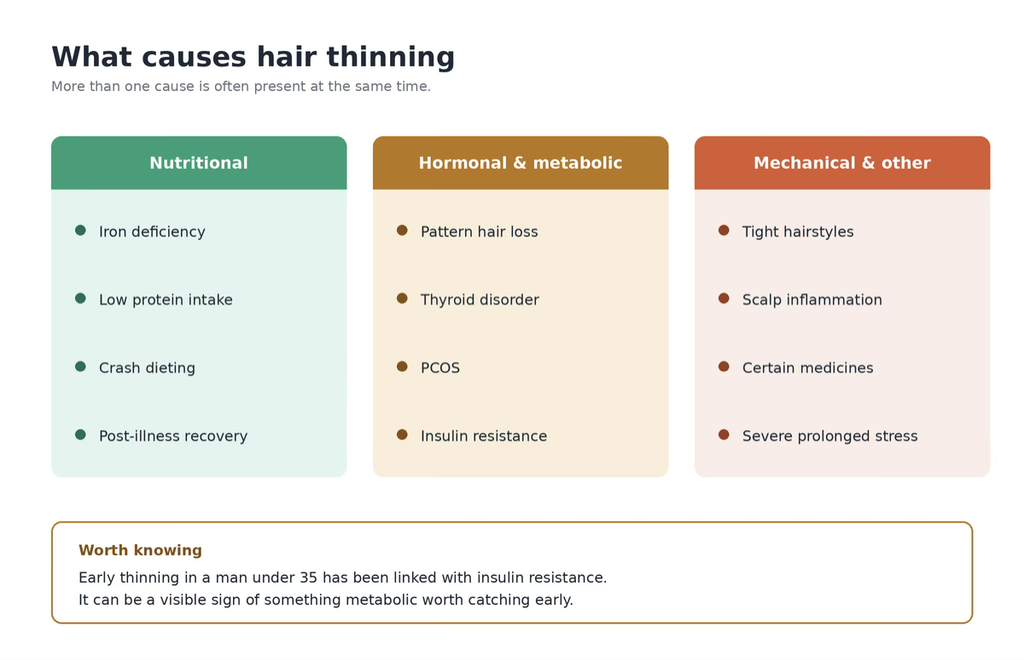
| Root cause | How it shows up | What it affects |
| Genetic / hormonal (pattern hair loss) | Gradual, patterned, widening parting or receding temples. Back and sides stay thick | Follicle miniaturisation |
| Iron deficiency | Diffuse thinning, often with fatigue, breathlessness, heavy periods | Follicle energy supply |
| Thyroid disorder | Diffuse thinning with weight change, fatigue, temperature intolerance | Growth cycle duration |
| PCOS | Thinning at the crown with irregular periods, acne, unwanted facial hair | Androgen effect on follicles |
| Protein or calorie shortfall | Follows crash dieting or rapid weight loss | Hair is low priority for a body under-fuelled |
| Insulin resistance | Early-onset thinning in a young man, often with weight gain around the middle | See below |
| Traction from tight styling | Thinning at the hairline, temples, or wherever hair is pulled | Mechanical follicle damage |
| Scalp inflammation | Thinning with flaking, itching, redness or scaling | Follicle environment |
| Certain medicines | Begins weeks to months after a new drug | Varies |
The root cause almost nobody mentions: insulin resistance.
This is worth knowing, particularly if you are a man under 35 noticing early thinning.
- A case-control study of 200 men aged 18–35 found that early-onset pattern hair loss was associated with significantly higher rates of insulin resistance and metabolic syndrome than in matched controls. The authors concluded that early thinning in young men may be a visible clinical indicator of underlying metabolic disturbance, and suggested routine metabolic screening for young men with advanced hair loss.
- A separate study at PGIMER Chandigarh found altered hormonal profiles and insulin resistance in roughly a third of men with early-onset pattern hair loss.
| What this means in practice: hair thinning at 25 is not only a cosmetic matter. It can be the first outwardly visible sign of something metabolic that is worth catching early , and that part is far more treatable than the hair. The equivalent in women is better known: thinning at the crown alongside irregular periods, acne or unwanted facial hair points towards PCOS, which is itself closely linked to insulin resistance. |
The blood test that gets missed
This is where a large share of hair thinning in India gets mishandled.
- Assam has one of the highest anaemia rates in the country. NFHS-5 found that 65.9% of women aged 15–49 in Assam are anaemic, well above the national figure of 57%, a rise of roughly 20 percentage points from the previous survey round.
- Iron deficiency is among the best-documented causes of diffuse hair thinning. Studies consistently find lower serum iron and ferritin in people with diffuse shedding than in those without it.
| Here is the gap. When someone reports hair fall, the usual test is a haemoglobin or a complete blood count. Haemoglobin measures iron circulating in the blood right now. Ferritin measures iron held in storage , and storage empties first. |
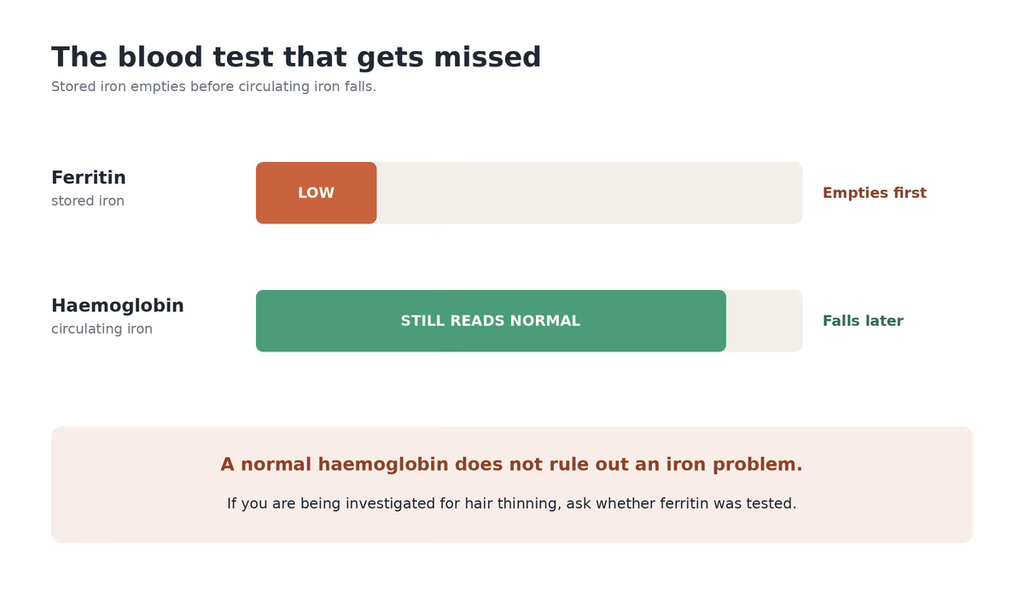
So you can have a normal haemoglobin, be told your reports are fine, and still have iron stores too low to support hair growth.
| Test | What it measures | What it tells you about hair |
| Haemoglobin / CBC | Iron circulating now | Only catches the problem once anaemia has developed |
| Ferritin | Iron in storage | Falls first , can be low while haemoglobin is still normal |
| TSH | Thyroid function | Both underactive and overactive thyroid cause thinning |
| Vitamin D | Vitamin D status | Associated with several forms of hair loss |
| Fasting glucose / HbA1c | Blood sugar | Relevant for early-onset thinning in young men |
Laboratory reference ranges treat ferritin commonly as normal from around 12–15 ng/mL, which is the threshold for anaemia, not the threshold for healthy hair. Dermatology literature associates levels below roughly 30 ng/mL with diffuse shedding. The exact optimum is still debated, but the gap between not anaemic and enough iron for hair is real.
What to do with this: if you are being investigated for hair thinning, ask specifically whether ferritin was tested. If only haemoglobin was done, that is the test to request.
How to prevent hair thinning
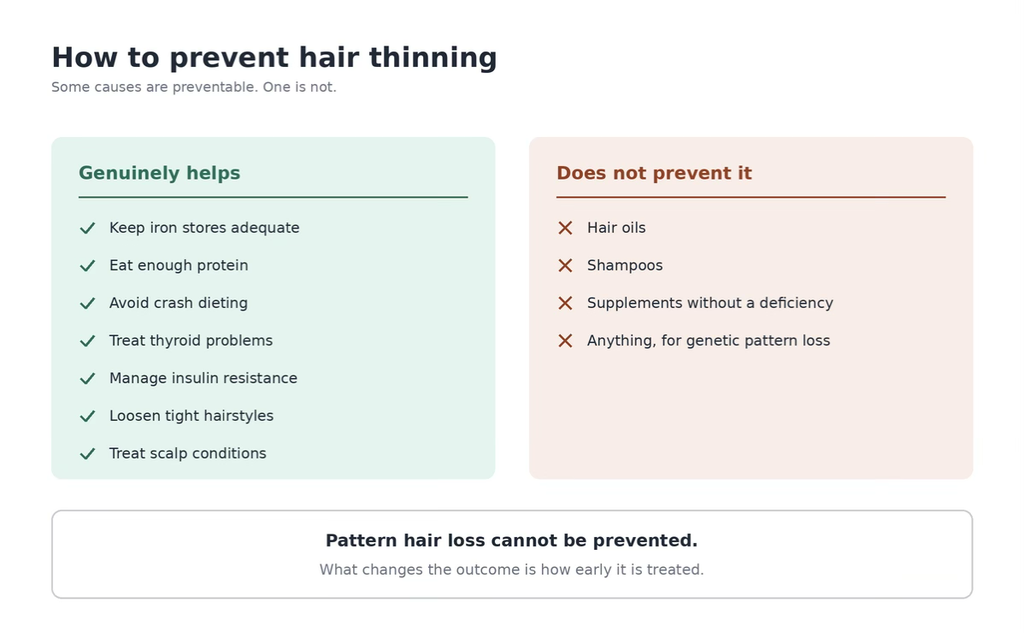
Prevention is honest work rather than a product list, and the division is sharp: some causes are preventable, one is not.
What genuinely helps
- Keep iron stores adequate: Particularly for women with heavy periods, vegetarians, and anyone post-pregnancy. Get ferritin checked rather than assuming.
- Eat enough protein: Hair is protein. Prolonged low intake shows up in hair before almost anywhere else, which is why crash diets so reliably cause thinning.
- Don’t crash diet: Rapid weight loss is one of the most consistent triggers of shedding, and repeated cycles compound it.
- Treat thyroid problems properly, and have thyroid checked if thinning comes with fatigue or weight change.
- Manage insulin resistance through weight, diet, and activity, relevant for both early-onset male thinning and PCOS.
- Loosen the hairstyle: Persistent traction from tight braids, buns and ponytails causes real, eventually permanent, follicle damage at the hairline. This one is entirely preventable.
- Treat scalp conditions rather than tolerating them: Chronic inflammation is bad for follicles.
- Get on top of post-illness recovery: After dengue, typhoid, or surgery, adequate nutrition for the following few months genuinely shortens the shedding that follows.
What Doesn’t Prevent Pattern Hair Loss?
Pattern hair loss is caused by genetics and hormones, so no product can stop you from being predisposed to it. However, catching it early with proven treatments can slow it down and help you keep as much hair as possible.
- Oils and Shampoos: Most oils and regular shampoos only coat the hair strand and clean the scalp; they don’t reach the hair roots where thinning actually happens. While keeping your scalp healthy is good, these products won’t prevent genetic hair loss. (Medicated shampoos like ketoconazole can help slightly with scalp inflammation, but they aren’t a main cure.)
- Supplements: Hair vitamins only help if you actually have a vitamin or mineral deficiency.
- Iron Risks: Taking iron when your iron levels (ferritin) are already normal will not help your hair grow. In fact, taking extra iron you don’t need can cause dangerous iron buildup and organ damage.
One caution. High-dose biotin can interfere with several laboratory blood tests, including thyroid and cardiac markers, producing misleading results. Tell the doctor before any blood test if you take a biotin supplement.
Hair thinning treatment options
Treatment follows the cause. This is why diagnosis comes first rather than after three failed products.
| If the cause is | Treatment |
| Iron deficiency | Iron supplementation, with the underlying cause of depletion investigated. Regrowth takes 3–6 months |
| Thyroid disorder | Treating the thyroid condition; hair follows |
| Post-illness or post-partum shedding | No specific treatment needed. Adequate nutrition and time. Recovery is the norm |
| Pattern hair loss | Topical minoxidil as first line, available over the counter. Prescription options exist and differ for men and women. Must be continued , stopping reverses the gains |
| PCOS | Treating the underlying hormonal picture, often alongside hair-specific treatment |
| Insulin resistance | Metabolic management, which helps considerably more than the hair alone |
| Traction | Stop the traction. Early cases recover; long-standing ones may not |
| Scalp inflammation | Treat the scalp condition; hair improves as inflammation settles |
Two things to be realistic about: Any treatment takes three to six months to show visible change, because that’s how long hair takes to grow. And treatment for pattern hair loss maintains and partially restores; it does not return hair lost years ago.
Procedures such as PRP and transplantation exist for established cases and are best considered after medical treatment has been tried.
When to see a dermatologist about hair thinning?
See one when the parting is widening, when the scalp shows where it didn’t before, when thinning has continued beyond six months, when there are bald patches, when the scalp is itchy, scaly, or painful, or when thinning comes with fatigue, weight change, or irregular periods.
The signs, the questions a dermatologist asks, and what happens in a consultation
Read more: Hair Fall Treatment in Guwahati: When Should You Consult a Dermatologist?
| The one not to wait on: thinning accompanied by scalp pain, scaling, or redness. Scarring conditions destroy the follicle permanently, and that is the one situation where delay genuinely costs hair that cannot come back. |
Working out which cause is yours
Most people with thinning hair cannot tell whether they need a blood test, a dermatologist, or simply time after an illness three months ago. That uncertainty is normal, and it is where most of the wasted money goes.
At Uzuhealth, a Health Counselor takes your history first and routes you accordingly, sometimes to a dermatologist, sometimes to a general physician when fatigue or weight change suggests something systemic, and sometimes to a ferritin and thyroid panel before any consultation at all. If tests are ordered, the Counselor arranges them and explains the results in plain language.
What to bring
- A photograph from one to two years ago. The single most useful thing you can provide, the parting comparison, is diagnostic.
- Current photographs: the parting from directly above, the crown, the hairline, all in daylight
- Recent and last 6 months of blood reports
- A list of all medicines and supplements
- The date of any fever, illness, surgery, childbirth, or significant weight loss in the past six months
Read More: Dermatologist in Guwahati: Which Skin Problems Actually Need One? · General Physician vs Specialist: When Do You Actually Need a Specialist?
In the End
Find a photograph of yourself from two years ago and look at the parting.
If it looks the same and hair is currently coming out in handfuls, you are shedding; think back to what happened two to three months ago, get ferritin and thyroid checked, and give it time. It recovers.
If the parting has widened, that is thinning, and it has been happening quietly for longer than you noticed. Waiting is the one approach that definitely doesn’t work, because every month of miniaturisation is hair that becomes harder to recover.
Frequently Asked Questions
1. What causes hair thinning?
Pattern hair loss, which is genetic and hormonal, is the most common cause. Others include iron deficiency, thyroid disorders, PCOS, insulin resistance, protein shortfall or crash dieting, tight hairstyles, scalp inflammation, and certain medicines. More than one cause is often present at once.
2. What’s the difference between hair thinning and hair fall?
Hair fall is hair coming out. Hair thinning is the hair growing back finer than the hair it replaced. Everybody sheds 50–100 hairs a day normally; thinning happens when the follicle shrinks over successive cycles and produces progressively finer hair. You can have thinning without any noticeable increase in hair fall.
3. Can hair thinning be reversed?
It depends on the cause. Thinning from iron deficiency, thyroid problems, illness, or crash dieting reverses once the cause is corrected, typically over three to six months. Pattern hair loss can be slowed and partially improved with treatment but will continue if untreated, and follicles lost years ago do not return.
4. Which blood test should I ask for?
Ferritin, TSH and vitamin D, plus fasting glucose for young men with early thinning. Ferritin matters most because it measures stored iron and falls before haemoglobin does; a normal haemoglobin does not rule out an iron problem. This is particularly relevant in Assam, where NFHS-5 found 65.9% of women aged 15–49 anaemic, against 57% nationally.
5. Why is my hair thinning at 25?
Early-onset pattern hair loss affects around 30% of men and begins before 30. Research has linked it with insulin resistance and metabolic syndrome in young men, which is why early thinning is worth investigating rather than just treating cosmetically. In women, early thinning with irregular periods or acne may point to PCOS.
6. Do oils, shampoos and supplements prevent hair thinning?
Oils and shampoos act on the hair shaft, not the follicle, so they neither cause nor prevent thinning. Supplements help only if you genuinely have the deficiency they contain. Note that high-dose biotin can distort thyroid and cardiac blood test results.
7. Does hair thinning after an illness or childbirth get better?
Usually yes. Shedding after a fever, dengue, surgery, or delivery typically begins two to three months afterwards and resolves over several months once the body recovers. Checking ferritin and thyroid is still worthwhile, as both are commonly affected.
8. How do I prevent hair thinning?
Keep iron stores adequate, eat enough protein, avoid crash dieting, treat thyroid and metabolic problems, loosen tight hairstyles, and treat scalp conditions rather than tolerating them. Pattern hair loss cannot be prevented, but treating it early determines how much hair you keep.
Disclaimer: This article is for general informational purposes only and is not a substitute for professional medical advice, diagnosis, or treatment. Always consult a qualified healthcare provider for any medical concern.