
It’s a Tuesday morning in August. You’ve had a fever since Sunday, the rain hasn’t stopped in days, and you have a full workday ahead. Do you push through, book a video call, or lose half the day at an OPD/Clinic?
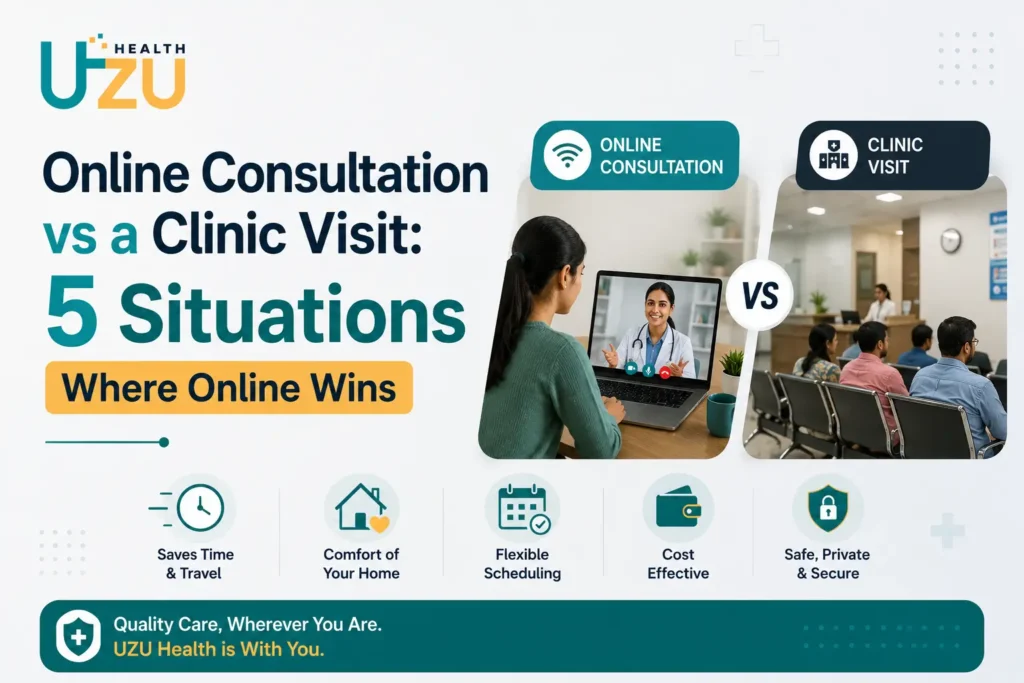
The short answer: in the online consultation vs a clinic visit, online wins whenever your condition can be understood by listening and looking: common illnesses, follow-ups on known conditions, prescription renewals, second opinions, and concerns you’d rather discuss privately. A clinic visit wins the moment a doctor needs to physically check your vitals, perform an examination, run a test on the spot, or in an emergency.
The harder and more useful question is: where does each of those situations stop being safe? A fever on day two is a phone call. The same fever on day five in Guwahati during dengue season is a blood test and a clinic visit. A normal Blood Pressure prescription refill is a five-minute conversation, unless, due to which, you are facing constant headaches or severe drowsiness; then you need to visit a clinic immediately.
This guide covers both.
Read More: how an online doctor consultation actually works
The real cost of choosing wrong
Most people frame this as convenience. It isn’t. It’s time, money, and occasionally something more serious.
The wait is the problem, not the doctor. Guwahati Medical College and Hospital handles roughly 18 lakh OPD patients a year, about 6,000 people through its gates on a working day. The consultation itself might take eight minutes. Everything around it takes the morning, which is exactly why online doctor consultation in Guwahati has grown as fast as it has here.
Travel and lost wages are the hidden bill: Research on outpatient care for chronic conditions in India found that travel costs and lost income account for close to two-thirds of the true cost of a hospital visit, well beyond the consultation fee. For a daily-wage earner, or a family traveling in from a district town, one OPD trip can mean a day’s income gone.
But the reverse error costs more: An online consultation for something that needed examining means you pay twice, once for the call, once for the visit you now need anyway, and you’ve lost a day in between. In a few situations, that delay is the part that matters.
Getting the choice right the first time is the entire point of understanding where the line sits.
5 situations where an online consultation vs a clinic visit is better
1. A common illness in its first few days
Fever, cold, cough, sore throat, mild acidity, an upset stomach. These fill most OPD benches, and the vast majority are diagnosed through careful questioning rather than physical examination. A doctor listening properly over video can usually tell you what’s happening and what to do.
This is also where the arithmetic is depressing: half a day spent to solve a ten-minute problem.
| Stop and get tested if the fever crosses day three or four without improving, comes with severe body ache or pain behind the eyes, or brings breathlessness, persistent vomiting, or a rash. This matters especially in Guwahati right now. Dengue cases in Assam peak from mid-August through November; historically, the large majority of Assam’s confirmed cases have come from Guwahati and its suburbs. No doctor, online or in a clinic, can distinguish dengue from an ordinary viral fever without a blood count test. What a good online consultation can do at that point is tell you which test to get and how urgently, which is genuinely useful and faster than a queue. |
Read more: Is Online Doctor Consultation Safe? What Patients in India Must Know
2. A follow-up for a condition already diagnosed
If you’re managing diabetes, hypertension, or thyroid and the diagnosis is established, a review rarely needs to happen in person. The doctor is checking your response to treatment and adjusting if needed- work that translates well to a call. Repeating a full clinic journey twelve times a year for a fifteen-minute review is exactly the cost this removes.
| A follow-up only works if there are numbers to follow up on. A diabetes review without a recent HbA1c or a set of home glucose readings, or a BP review without a recent health checkup, is a conversation rather than a consultation. While booking the call, upload or share your blood report/health checkup report to get a better review. If nobody has measured anything in months, the honest sequence is: test, then consult. And if you can’t get to a lab,a home visit that includes vitals is a better use of your money. |
3. A prescription renewal that hasn’t changed
Simpler still. Sometimes you need an existing prescription reviewed and reissued, nothing more. If nothing has changed and the doctor has your history, that’s a short conversation, not a reason to take a morning off.
| Not every medicine can be renewed online, and the rules are specific: if your medicine requires periodic blood monitoring, or if you’re asking for something new rather than a repeat, expect the doctor to want more than a phone call. |
4. A second opinion before a major decision
If a doctor has recommended a procedure, a significant treatment change, or delivered a serious diagnosis, wanting another view is entirely reasonable. But booking a second full appointment, with another long wait, can feel like too much at an already stressful time. Online lets you share your reports and get an independent view quickly.
| A second opinion is only as good as what you send. Reports, scans, discharge summaries, and the first doctor’s actual prescription , not your summary of it. If the second opinion would genuinely require examining you (a lump, a joint, anything the first doctor found by hand), an online second opinion can review the reasoning but can’t independently verify the finding. Know which one you’re getting. And if the underlying question is which kind of doctor you should be asking in the first place. Read More: whether you need a specialist at all. |
5. A concern you’d rather not discuss in a waiting room
Mental health, Sexual health, Skin concerns somewhere you’d rather not point at in a shared room. Some conversations are easier from your own space than in a clinic. This is clinical, not just social. A patient who leaves out a detail from embarrassment is a patient being treated on incomplete information, and privacy demonstrably changes what people are willing to say.
| If the concern has something physical attached to it, a lump, discharge, bleeding, a lesion- the privacy advantage doesn’t override the need to be examined. Start online if that feels easier. One legal note worth knowing: Medicines under India’s Prohibited List, which includes most sedatives and anti-anxiety drugs classed under the NDPS Act, cannot be prescribed by teleconsultation at all. For mental health, an online consultation is an excellent first door, but some treatment paths will require an in-person visit by law. |
What can a doctor legally prescribe in an online consultation vs a clinic visit?
This is the part almost nobody explains, and it’s the difference between feeling let down by a teleconsultation and understanding exactly what you’re getting. It sits inside the legal framework behind online consultation, which covers prescription validity and your data rights in more depth.
Under India’s Telemedicine Practice Guidelines 2020, medicines fall into four categories that determine what can be prescribed remotely, and when.
| Category | What it covers | What it means for you |
| List O | Over-the-counter medicines, paracetamol, ORS, common cough preparations | Can be prescribed by any mode: video, phone, or text |
| List A | Relatively safe medicines with low misuse potential, eye and skin preparations, some oral diabetes medicines | A live video consultation is required the first time. Refills afterward can be done by phone or text |
| List B | Add-on medicines to optimize treatment of a condition you’re already being treated for | Only in a tele-follow-up, the same doctor, the same condition, within six months of an in-person visit |
| Prohibited List | Schedule X medicines and substances under the NDPS Act, 1985 | Cannot be prescribed online at all, by any doctor, on any platform |
Three things follow from this table:
- If a platform offers you a prescription without an actual consultation, it is operating illegally and cutting corners.
- “Video required for first prescription” is a patient protection, not a sales tactic. A service that insists on it is following the rules.
- A doctor declining to prescribe something online isn’t being unhelpful. In many cases, they are legally barred from it.
| Note: Alongside this, the guidelines require that your doctor be registered with the National Medical Commission or a State Medical Council, and that their registration number appears in every communication with you, including the prescription. You can verify any number yourself on the NMC’s public Indian Medical Register. |
When is a clinic visit non-negotiable?
No guide will claim that online replaces in-person care. Go in person, or straight to a hospital, when:
- It’s an emergency
Severe chest pain, excessive breathing difficulty, sudden one-sided weakness, convulsions, uncontrolled bleeding, unconsciousness, or a child who is unusually drowsy and unresponsive. If you’re unsure whether it’s an emergency, treat it as one.
- Something needs measuring or examining
To check extreme High or low Blood pressure, oxygen saturation, listening to the chest, feeling a swelling, examining a wound. And if a doctor has already told you to come in, online or otherwise, go. That instruction is the consultation doing its job.
- The symptoms are new but in extremely worse condition, severe, or worsening fast. Safer assessed in person, at least the first time.
Read more: Home Visit vs Online Consultation: Which One Does Your Situation Need?
#A home visit sits between these two options and often resolves cases where neither feels right.
Online consultation vs a clinic visit: at a glance
| Your situation | Better option | Why |
| Fever, cold, cough, acidity, first 2–3 days | Online | Diagnosed by history, not touch |
| Fever past day 3–4, or with severe body ache | Clinic or test first but for test first you can consult online first | Dengue and typhoid need bloodwork; consult online first, wait for the prescription, then go for a follow-up consultation. After that, also if required, the doctor will call you to see in-person. |
| Stable diabetes or BP follow-up, recent readings available | Online | Review and e-prescription in one call |
| Chronic follow-up, no readings for months | Test first, then online | Nothing to review otherwise |
| Repeat prescription, nothing changed | Online | Short conversation |
| New medicine being requested | Depends on drug list | Video may be legally required |
| Second opinion on existing reports | Online | Reports share digitally |
| Second opinion requiring a physical finding | Clinic | Can’t verify by camera |
| Mental health, sexual health, women’s health | Online first | Privacy improves disclosure |
| Concern with a lump, discharge, or bleeding | Clinic | Needs examination |
| Skin rash or acne | Online (video) | Visible on camera |
| Elderly patient, weak, hard to assess remotely | Home visit | Vitals plus examination at home |
| Emergency symptoms | Hospital, immediately | No consultation of any kind |
What to keep ready before an online consultation?
Ten minutes of preparation changes the quality of what you get back. If this is your first time, the step-by-step guide for first-timers walks through the booking process itself.
For any consultation
- When symptoms started, and whether they’re improving or worsening
- Your current medicines: photograph the strips rather than trying to recall names
- Any known allergies and existing conditions
For a chronic follow-up
- Your most recent readings: HbA1c, BP log, thyroid panel, whatever applies
- The previous prescription
- Any side effects you’ve noticed since the last review
For a second opinion
- All reports and scans, uploaded before the call
- The first doctor’s written prescription and recommendation
- The specific question you want answered
The final decision
Most people aren’t unsure whether online consultation is safe. They’re unsure whether it’s right for this problem, a harder question to answer when you’re not feeling well enough to think it through.
That’s what a Health Counselor does. At Uzuhealth, before anything is booked, your Counselor listens to what’s actually happening and helps you decide: an online consult, a test first, a home visit, or an in-person referral if that’s what the situation needs. If your fever has crossed day four, you’ll be told to get a blood count before booking a call, because that’s the useful answer, not the convenient one.
→ Book an Online Consultation with Uzuhealth
1. Online consultation vs clinic visit, which should I choose?
Choose online for common illnesses in their early days, follow-ups on a known condition where you have recent readings, prescription renewals, second opinions on existing reports, and sensitive concerns. Choose a clinic when vitals or a physical examination are needed, when symptoms are new, severe, or worsening, or in any emergency.
2. When should I stop treating a fever online and get tested?
If a fever persists past three to four days without improvement, or comes with severe body ache, pain behind the eyes, persistent vomiting, breathlessness, or a rash. In Assam, dengue cases peak between mid-August and November, and no doctor can rule it out without a blood test; more on when a fever needs a test in Guwahati.
3. Can any medicine be prescribed in an online consultation?
No. Under the Telemedicine Practice Guidelines 2020, medicines fall into four lists. Any mode can prescribe over-the-counter medicines. Some require a live video consultation first. Add-on medicines require a follow-up with the same doctor. Schedule X medicines and substances under the NDPS Act cannot be prescribed online at all.
4. Is an online prescription valid in India?
Yes, when issued by a Registered Medical Practitioner through a legitimate teleconsultation. A valid e-prescription carries the doctor’s name, qualification, registration number, date, dosage details, and a digital signature, and is accepted at pharmacies and labs.
5. How do I know the doctor is real?
The doctor’s registration number must appear in every communication with you, including the prescription. You can verify it on the National Medical Commission’s public Indian Medical Register. If no registration number is visible, that is a red flag, not an oversight. Here’s how to check a platform is legitimate in two minutes.
6. How much time does an online consultation save?
A clinic visit means travel, waiting, consultation, and the journey back, often half a day. An online consultation typically runs 10–20 minutes end to end. Research on outpatient care in India indicates travel and lost wages make up close to two-thirds of a hospital visit’s true cost.
7. Can I get a second opinion online?
Yes. Upload your reports and the first doctor’s recommendation before the call. Note that an online second opinion can review the reasoning behind a diagnosis but cannot independently verify a physical finding.
8. What if I’m not sure which my situation needs?
That uncertainty is normal and common. Describing your symptoms to a Health Counselor before booking means you’re guided to the right form of care, including being told to get a test first, if that’s the honest answer.
Disclaimer: This article is for general informational purposes only and is not a substitute for professional medical advice, diagnosis, or treatment. Always consult a qualified healthcare provider for any medical concern.