

You’re unwell, maybe with a fever, a bad stomach, or a cough that won’t settle. You drag yourself to the clinic, wait in a queue or crowded room, and watch an hour disappear before the doctor can even see you. By the time your turn comes, you have even less energy than when you walked in.
There’s another way, and it’s already mainstream. India’s own government telemedicine service, eSanjeevani, has completed over 43 crore (430 million) doctor consultations as of November 2025, making it the largest telemedicine service in the world. Assam was one of the early states to embrace it. In Assam, the National Telemedicine Service has already served more than 29,39,262 patients at 4767 Ayushman Arogya Mandirs (earlier called Health & Wellness Centers) as spokes, through 43 hubs (set up at secondary- and tertiary-level health facilities and medical colleges, etc.), as on 20 November 2025.
So if there’s a worry at the back of your mind, “Is this real? Is it safe? Is it some kind of scam?” here’s the simple answer: online consultation is a regulated, government-recognized way to see a real, qualified doctor. Crores of Indians, including thousands right here in Assam, already use it every month.
But how does it actually work? Is the prescription valid? Can a doctor really help without examining you in person? This guide explains everything step by step.
What is an online doctor consultation?
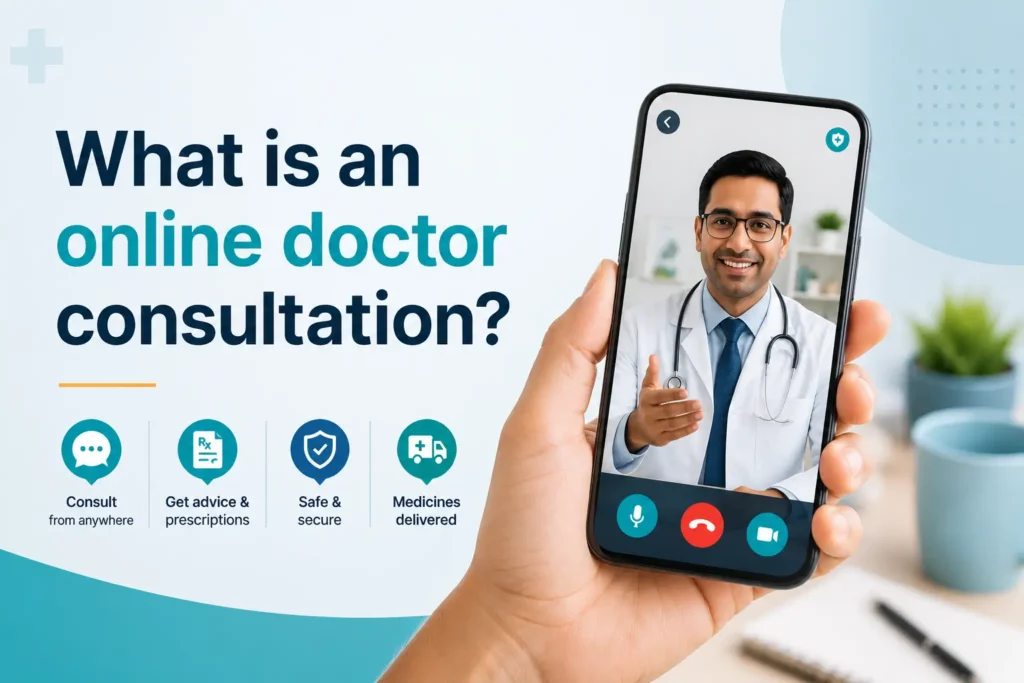
Online doctor consultation, also called teleconsultation or telemedicine, is a medical consultation conducted remotely, via your phone or computer, rather than in a clinic. You connect with a registered, qualified doctor via chat, phone, or video, describe your concern, and receive advice, a diagnosis, and a prescription.
The key thing to understand is that this is not the same as typing your symptoms into a search engine and hoping for the best. You’re speaking with an actual medical professional who is registered to practice, the same kind of doctor you’d see in a clinic. The only thing that changes is that you see them from the comfort of your home.
Online consultation vs a traditional clinic visit: what’s different?
Quite a lot stays exactly the same. You still get a qualified doctor, a proper assessment of your symptoms, a diagnosis, and a valid prescription if you need medication. What changes is everything around the consultation: there’s no travel, you choose the slot to meet the doctor online, there’s no sitting in a crowded waiting room, and you usually wait far less to actually speak to someone.
What a clinic visit offers that online can’t is physical examination, listening to your chest, checking your throat with an instrument, taking your blood pressure, or ordering an immediate test on the spot. But heart rate, O2 levels, heartbeat, and BP can also be monitored through phone apps or smart wearables, such as watches and rings.
The three ways to consult: chat, phone, and video
Most platforms let you choose how you want to consult, and each format suits a different situation:
- Chat (text) consultation works best for quick, non-urgent questions, minor queries, dosage clarification, or simple follow-ups. It’s convenient and discreet, and you have a written record afterward.
- A phone consultation suits situations where you need to describe how you’re feeling in detail or talk something through. It’s more personal than chat and faster to express yourself.
- Video consultation is the closest thing to being in the room with a doctor. Choose this when the doctor may need to see something, such as a skin rash, fever, swelling, how you’re breathing, or the appearance of an eye or wound.
A good rule of thumb: the more the doctor needs to observe, the more you should lean towards video.‘
How does an online doctor consultation actually work?
Step 1: Choose a trusted platform
Start with a platform that clearly shows its doctors’ qualifications and registration details, has transparent pricing, and protects your data. This matters more than it might seem: a trustworthy platform is the difference between a proper medical consultation and a risky shortcut.
Here’s something most people don’t realize until they’ve tried it: a lot of apps or websites leave you completely on your own. You scroll through hundreds of doctor profiles while you’re already feeling unwell, pick one yourself, and hope you chose right.
The better platforms remove that guesswork. Uzuhealth, for instance, gives every patient a personal Health Counselor, a real human who listens to your problem first and then helps you reach the right doctor, so you’re never left navigating it alone.
Step 2: Talk through your problem and get matched to the right doctor
For most everyday issues, fever, cold, stomach upset, body ache, a general physician is the right starting point. If your concern is more specific, such as a skin problem or a heart-related issue, you’ll need to see the relevant specialist.
Knowing which doctor to see is exactly where many people get stuck. With UzuHealth, you don’t have to figure this out yourself; your Health Counselor takes down your symptoms and medical history, then matches you with the right specialist and books your slot. It’s the difference between guessing and being guided.
Step 3: Share your symptoms and history
Before the consultation, you’ll be asked about your main complaint, how long you’ve had it, and any existing conditions or medications. A small tip that makes a big difference: note down your symptoms beforehand.
With a counselor-led service, this part is already done for you; your details are passed to the doctor in advance, so the doctor is fully prepared before your call even begins.
Step 4: The consultation itself
This is where you actually speak with the doctor, usually over a video call. They’ll listen to your concern, ask follow-up questions to understand it properly, and assess your situation, exactly as they would in a clinic. Most consultations take somewhere between ten and twenty minutes. Be specific and honest; the more accurately you describe what’s going on, the better the advice you’ll receive.
Step 5: Your prescription and guided next steps
If medication is needed, the doctor issues a digitally signed prescription that you’ll receive right after the consultation. It’s legally valid and accepted at any pharmacy or for booking lab tests. The doctor may also recommend a test, suggest a follow-up, or, if your situation calls for it, advise you to visit a clinic in person.
This is another point where being left alone can be frustrating: you get advice, but no idea where to go next. A guided service closes that gap.
On Uzuhealth, your Health Counselor stays with you after the call, explaining the doctor’s recommendations in simple language, helping arrange any lab tests, and following up to see how you’re feeling. Your care doesn’t end when the video call does.
Is online doctor consultation legal in India?
Yes. Online consultation in India is governed by the Telemedicine Practice Guidelines, 2020, issued by the Ministry of Health and Family Welfare and now overseen by the National Medical Commission. These guidelines give telemedicine a clear legal framework.
In practical terms, this means three things for you as a patient: only registered medical practitioners may consult online, your explicit consent is required before any consultation, and prescriptions issued through a proper teleconsultation are legally valid. In other words, the system is regulated.
Who benefits most from online consultation?
Online consultation isn’t right for every situation, but for some people it’s a genuine game-changer:
- Working professionals who can’t keep taking time off and can fit a consultation into a lunch break instead.
- People in outer areas and smaller towns across Assam, where reaching a specialist in the city can mean a long, costly journey. Online access removes that barrier entirely.
- Patients managing ongoing conditions like diabetes, blood pressure, or thyroid issues, who need regular follow-ups and prescription renewals without a clinic trip each time.
- Parents of young children, especially when something flares up late at night or over a weekend.
What online consultation can’t replace
It’s worth being clear-eyed about the limits. Online consultation is not for high-risk medical emergencies, chest pain, difficulty breathing, serious injury, or any situation requiring urgent hands-on care, so you should head to a hospital immediately. It also can’t do the things that require physical presence: a thorough physical examination, certain on-the-spot tests, or procedures. For these, an in-person visit remains essential. Used for the right situations, though, online consultation is a fast, reliable, and properly regulated way to get the care you need.
Conclusion
Here’s the truth most health apps won’t tell you: being unwell is hard enough without having to play detective, too. Which doctor? Which specialist? What do these test results mean? Where do I go next? When you’re tired and worried, those questions pile up fast, and most platforms hand you a list and walk away.
Uzuhealth was built on the opposite idea. From the moment you reach out, a personal Health Counselor is in your corner, listening to your problem, matching you to the right specialist, preparing the doctor before your call, and staying with you long after it ends to handle tests, follow-ups, and anything you don’t understand, guiding your whole journey.
You don’t need to be tech-savvy. You don’t need to know the right doctor. You don’t need to do this alone. You just need to take the first step: speak to your counselor, and someone will walk the rest of the way with you.
Your health deserves a guide, not a guessing game. Book your consultation with Uzuhealth today.
→ Consult a doctor online with Uzuhealth
FAQ’s
1. How much does an online doctor consultation cost in India?
Fees vary by platform and the type of doctor you consult. A general physician consultation typically ranges from around ₹200 to ₹800, while specialist consultations cost more. The exact fee is always shown before you confirm your booking, so there are no surprises.
2. Is a prescription from an online consultation valid?
Yes. A prescription issued by a registered medical practitioner through a proper teleconsultation is legally valid in India and is accepted at pharmacies, both physical and online. A valid e-prescription includes the doctor’s name, qualification, and registration number.
3. What health problems can be treated through online consultation?
Online consultation works well for a wide range of everyday concerns, such as fever, cold, and cough, throat infections, acidity and indigestion, minor skin issues, allergies, urinary tract infections, and follow-ups for ongoing conditions like diabetes or blood pressure. It’s also useful for second opinions and sensitive concerns you’d rather discuss from home.
4. Can a doctor diagnose me properly without examining me in person?
For many common conditions, yes. Doctors are trained to assess a great deal through careful questioning and, in a video consultation, visual observation. If your condition genuinely requires a physical examination or a test, the doctor will tell you and recommend an in-person visit, as honesty is part of responsible care.
5. Is online consultation safe and private?
On a trustworthy platform like Uzuhealth, yes. Reputable services use secure, encrypted systems to protect your consultation and medical information, and your conversation with the doctor is confidential. Before sharing health details, check that the platform displays a clear privacy policy and shows its doctors’ registration details.
6. Should I choose chat, phone, or video consultation?
It depends on your concern. Chat suits quick, simple queries; phone is better when you need to describe symptoms in detail; and video is best when the doctor needs to see something, such as a rash, fever, swelling, or how you’re breathing. When in doubt, the video option is the best.
7. Can I consult a doctor online for my child or elderly parent?
Yes. You can book a consultation on behalf of a family member, including children and elderly parents. Just be ready to describe their symptoms and share any relevant medical history or medications they’re currently taking.