
“মই ঠিকেই আছোঁ, তই চিন্তা নকৰিবি।“
(I’m fine, don’t you worry.)
If you have an ageing parent, you have heard this sentence. You have probably heard it on a day when they were not fine.
It is rarely a lie. It is a kindness, offered by a generation that does not want to be a burden, to children who are already managing jobs, their own children, and often a different city altogether.
Here is the thing most families discover late: elderly care in Guwahati is decided less by which hospital you choose than by three things sitting inside the house. The medicine box, the floor, and the kitchen. None of them are visible in an OPD.
This guide covers what those three things do to an older person’s health, when a doctor at home for senior citizens in Guwahati is the right call, and, equally important, when it is the wrong one and a hospital is what’s needed.
Why does elderly care in Guwahati carry a particular risk?
- Assam has roughly 29 lakh senior citizens, and the number climbs every year. Nationally, India’s population aged 60 and above is projected to more than double from around 100 million in 2011 to 230 million by 2036, at which point nearly one in seven Indians will be a senior citizen.
- Three findings shape what elderly care here actually has to deal with.
- Assam carries one of the highest illness burdens in the country. Analysis of the Longitudinal Ageing Study in India (LASI), the country’s largest survey of older adults, found that Assam recorded the second-highest prevalence of single morbidity among older adults in India at 23.2%, behind only Odisha. Nationally, around 51% of adults over 60 live with two or more chronic conditions.
- Falls are far more common than families realise: A 2026 analysis of LASI data found that 22.2% of Indians aged 60 and above had fallen in the previous two years, rising to 25.7% among women. The same analysis found depression in 30.6%, vision impairment in 27.6%, and underweight status in 26.1% of older adults.
- And the Northeast leads the country in one specific risk: A systematic review of 27 Indian studies found that polypharmacy, taking five to nine medicines at once, was most prevalent in Northeast India at 65%, the highest of any region in the country. Across India, 28% of older adults were taking at least one potentially inappropriate medication.
Read those together and a picture forms. The older patient in Guwahati likely has more than one condition, is taking more medicines than almost anywhere else in India, and has a one-in-five chance of a recent fall they probably didn’t mention.
The three things that live in the house, not in the patient
This is what makes a home visit clinically different, rather than simply more comfortable.
- The medicine box
Ask an elderly patient in a clinic what they’re taking, and you get an approximate answer, some names, some descriptions by colour, one or two forgotten. Ask them at home, and they hand you the box.
That box is usually revealing. Medicines from three doctors who have never spoken to each other. A strip that expired eighteen months ago. Two tablets doing the same job under different brand names. Something a neighbour recommended. A blood pressure medicine finished a fortnight ago and never refilled, because nobody wanted to make the trip.
With the Northeast recording India’s highest rate of polypharmacy, and roughly one in four older Indians on a medicine that may be inappropriate for their age, this isn’t housekeeping. A proper medicine review is among the highest-value things a doctor can do for an older patient, and it is far easier standing in front of the actual box.
- The floor
More than one in five older Indians has fallen in the past two years, and a fall in an elderly patient is rarely a small event. An Indian study following 279 hip fracture patients for a year found one-year mortality of 19%, higher, the authors noted, than for heart attack or breast cancer in a comparable population. A fractured hip at 75 changes everything that follows.
Fall risk is largely environmental, and invisible from a consulting room: a loose rug at the bedroom door, a bathroom with no grab rail and a wet floor, a dim corridor on the way to the toilet at night, stairs without a handrail, a bed too low to rise from easily.
A doctor walking through the house sees all of this in two minutes. A doctor in an OPD can only ask, “Have you had any falls?” and get the answer “মই ঠিকেই আছোঁ.”
- The kitchen
Underweight status affects roughly a quarter of older Indians. The causes are usually mundane and entirely fixable: dentures that don’t fit, so food gets avoided. Cooking that became too tiring, so meals became tea and biscuits. A diabetic diet followed so strictly that total intake dropped far too low.
None of this reliably surfaces in a seven-minute consultation. All of it is visible in a kitchen.
The point isn’t that an OPD doctor is less skilled: It’s that three of the most important variables in elderly health are physically located in the house. A doctor who is in the house can assess them. A doctor in a clinic depends on what the patient chooses to report, and a generation raised not to be a burden is not a reliable reporter.
When should a doctor come home?
Arrange a home visit when any of the following applies.
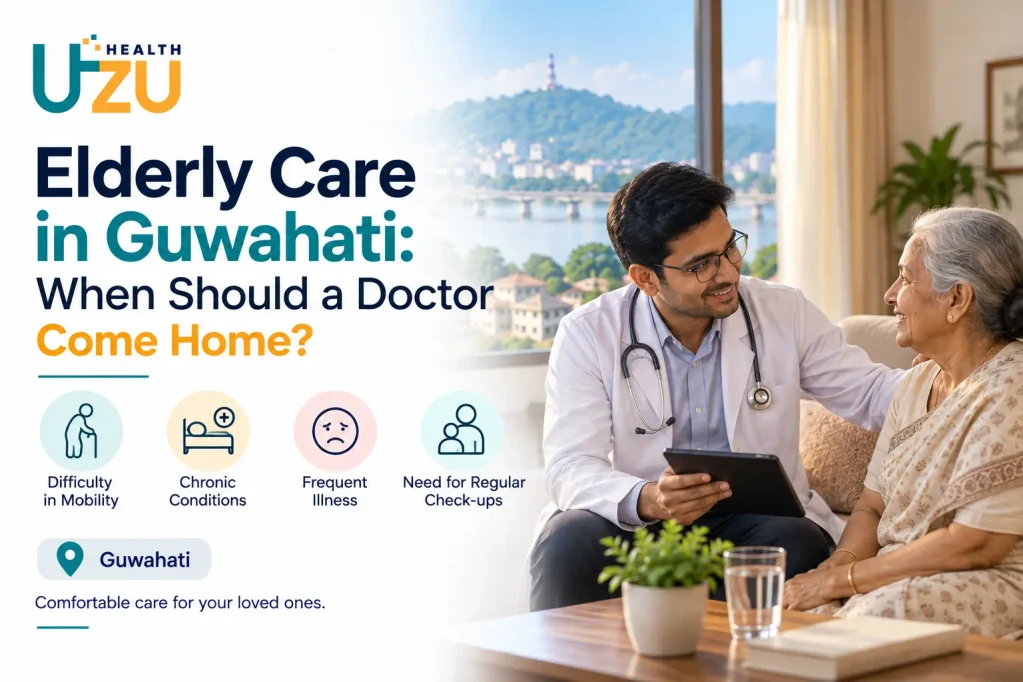
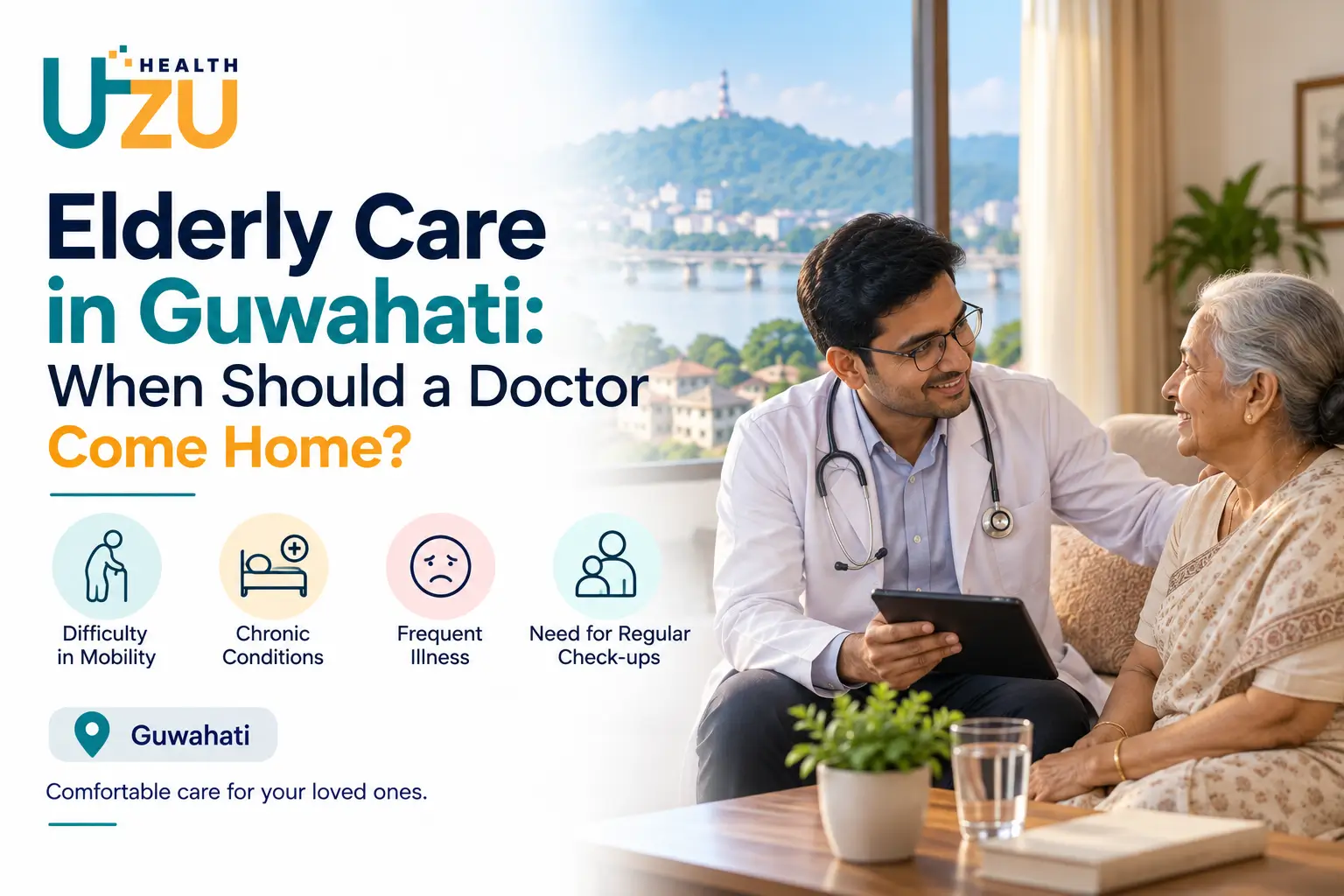
- Travel itself has become the obstacle: Weak knees, poor balance, breathlessness on stairs, or simply the exhaustion of an auto ride and a long wait.
- A chronic condition needs regular review: Diabetes, hypertension, thyroid, heart conditions, arthritis- these need unhurried monitoring, not a rushed slot every few months.
- The patient is recovering from surgery or a hospital stay: Wound checks and recovery monitoring, without disrupting the rest recovery depends on.
- Nobody has reviewed all the medicines together: Especially if more than one doctor is prescribing, or the number of tablets has crept up over the years.
- There has been a fall, or a near-fall: Even one. This is the single most under-reported event in elderly health.
- Something has changed, and nobody can name it: Eating less, sleeping differently, more confused, withdrawn, not themselves. Vague changes in an older person deserve assessment, not reassurance.
- You live in another city: A visit you can arrange remotely, with a report back afterwards, closes a gap phone calls cannot.
- They are refusing to go to hospital: Extremely common, and it usually ends with nobody being seen at all. A doctor at the door removes the argument entirely.
Read More: Why More Guwahati Families Are Choosing Doctor at Home Services
What good elderly care in Guwahati actually involves?
A home visit is a full consultation, not a reduced one.
| What happens | What it covers |
| Vitals | Blood pressure, pulse, temperature, oxygen saturation, blood sugar where indicated |
| Physical examination | Chest, abdomen, joints, wounds, swelling , everything a clinic examination includes |
| Medicine review | Every strip in the house, checked together for duplication, interactions and age-appropriateness |
| Functional assessment | Mobility, balance, how they rise from a chair, how steady they are walking |
| Environment check | Fall hazards, lighting, bathroom safety |
| Family conversation | Questions answered directly, with the people who actually manage the care |
| Next steps | Which tests are needed, which referrals, what to watch for |
What it cannot do is the same for every home visit: no scans, no endoscopy, no procedures, no emergency care. A home visit establishes what is needed. It does not replace a hospital when a hospital is what’s required.
When a home visit is not the right answer?
Being clear about this matters more than being comprehensive, and any service that won’t tell you is selling rather than advising.
- Go to hospital immediately; don’t book anything first, for chest pain, difficulty breathing, sudden weakness on one side, slurred speech, a facial droop, convulsions, uncontrolled bleeding, a serious fall with suspected fracture, or unconsciousness.
- A hospital is the right choice when advanced diagnostics are needed (CT, MRI, endoscopy), when a procedure is required, or when the patient is already under a specialist’s active care for a serious condition.
- An online consultation is often enough, and considerably cheaper, for a routine follow-up where recent readings already exist, a prescription review, interpreting a blood report, or a second opinion on a specialist’s recommendation.
Warning signs in an older patient that should not be ignored
Illness presents differently in older people. These are the signs families most often miss.
| Warning sign | Why it matters |
| Sudden confusion or disorientation | Often the first sign of infection in an elderly patient, before any fever |
| A fall, even without injury | Signals an underlying problem , balance, blood pressure, medication, vision |
| Not eating, or a marked drop in appetite | A recognised early indicator of several serious conditions |
| New breathlessness on usual activity | Needs assessment, not observation |
| Swelling of feet or ankles | Can indicate heart, kidney or liver involvement |
| Withdrawal, loss of interest, not speaking as usual | Depression affects roughly 30% of older Indians and is routinely mistaken for ageing |
| Fever in someone frail or diabetic | Infections progress faster and need earlier attention |
| Sudden weakness, facial droop, slurred speech | Go to hospital immediately , possible stroke |
Elderly care in Guwahati: online, home visit, or hospital?
| The situation | Best option | Why |
| Routine chronic review, recent readings available | Online consultation | Nothing needs measuring |
| Chronic review, no readings for months | Home visit | Vitals taken on the spot |
| Patient cannot travel comfortably | Home visit | Travel is the obstacle |
| Post-surgery or post-hospital recovery | Home visit | Wound and recovery check without disrupting rest |
| Medicines never reviewed together | Home visit | The box is in the house |
| After a fall | Home visit | Environment and balance both need assessing |
| Prescription refill, nothing changed | Online consultation | Short conversation |
| Scan, endoscopy, or procedure needed | Hospital | Equipment cannot travel |
| Emergency symptoms | Hospital, immediately | No consultation of any kind |
Arranging elderly care in Guwahati
Through Uzuhealth, home visit consultations start at ₹1,500 for locations within 10km and ₹2,000 within 15km, with same-day visits available when needed. Terms and conditions apply.
Working in collaboration with Arya Hospital, one of Guwahati’s most trusted institutions, Uzuhealth has served over 500 families across the city.
Before the doctor arrives
Four things that make a home visit substantially more useful:
- Gather every medicine in the house into one place. All of them: current, old, prescribed, bought over the counter, recommended by relatives. This is the single most valuable preparation you can make.
- Find the last prescription and any recent reports. Blood tests, discharge summaries, scan reports.
- Write down what has changed, and when. Appetite, sleep, mood, mobility, memory.
- Mention any fall, even a minor one, even if the patient says it was nothing.
If you are arranging this from another city
This is the common case now, not the unusual one, and it’s where coordination matters more than the consultation itself.
At Uzuhealth, a Health Counselor speaks with you first, understands the patient’s condition, answers your questions, and coordinates the right doctor to visit. Afterwards, the Counselor stays with the case: arranging any tests the doctor orders, explaining the advice in plain language, and following up to check the patient is recovering.
For a son in Bengaluru or a daughter in Dubai, that continuity is usually the actual product. You aren’t buying a consultation. You’re buying someone in Guwahati who knows your parent’s situation and will tell you the truth about it.
Read More: Managing Your Parents’ Health From Abroad: An NRI Guide
Finally
Most families arrange their first home visit during a crisis. The more useful version happens six months earlier, when nothing is obviously wrong: a full review, a proper look at the medicine box, a walk through the house, and an honest conversation about what to watch for.
That visit is unglamorous and rarely produces a dramatic finding. It is also the one most likely to prevent the crisis.
If your parent has been saying they’re fine for a while now, that is worth checking rather than accepting.
Frequently Asked Question
1. What does elderly care in Guwahati usually involve?
For most older patients, it means regular review of chronic conditions, a periodic check of all medicines together, monitoring after any hospital stay or surgery, and attention to mobility and nutrition. Much of this is better done at home, where the medicines, the living environment, and the kitchen can all be assessed directly.
2. When should I arrange a doctor at home for senior citizens in Guwahati?
When travel has become difficult, when a chronic condition needs regular review, after surgery or a hospital discharge, after any fall, when nobody has reviewed all the medicines together, when something has changed and nobody can name it, or when the patient refuses to go to hospital.
3. What does a home visit doctor actually check?
Vitals including blood pressure, pulse, and oxygen saturation, a full physical examination, a review of every medicine in the house, mobility and balance, fall hazards in the home, and a direct conversation with the family about next steps.
4. Is a home visit as good as a hospital visit for elderly care in Guwahati?
For routine review, chronic condition management, recovery monitoring, and common illnesses, a home visit provides the same clinical care with more time and no travel strain, plus assessment of medicines and home safety that a hospital cannot do. For advanced diagnostics, procedures, and emergencies, a hospital remains necessary.
5. How much does a doctor home visit cost in Guwahati?
Through Uzuhealth, home visits start at ₹1,500 within 10km and ₹2,000 within 15km. Terms and conditions apply.
6. Can I arrange care for my parents if I live in another city or abroad?
Yes. Many families arrange visits remotely. A Health Counsellor coordinates the visit, speaks with you beforehand, and follows up afterwards, so distance isn’t a barrier.
7. My parent takes a lot of medicines. Is that a problem?
It’s worth reviewing. Northeast India records the country’s highest rate of polypharmacy, and around 28% of older Indians take at least one medication that may be inappropriate for their age. If several doctors are prescribing, or the tablet count has grown over the years, one doctor reviewing everything together is genuinely valuable.
8. What symptoms mean hospital rather than home-based elderly care in Guwahati?
Chest pain, difficulty breathing, sudden weakness on one side, slurred speech or facial droop, convulsions, uncontrolled bleeding, a serious fall with suspected fracture, or unconsciousness. These need emergency care immediately.
Disclaimer: This article is for general informational purposes only and is not a substitute for professional medical advice, diagnosis, or treatment. Always consult a qualified healthcare provider for any medical concern.