

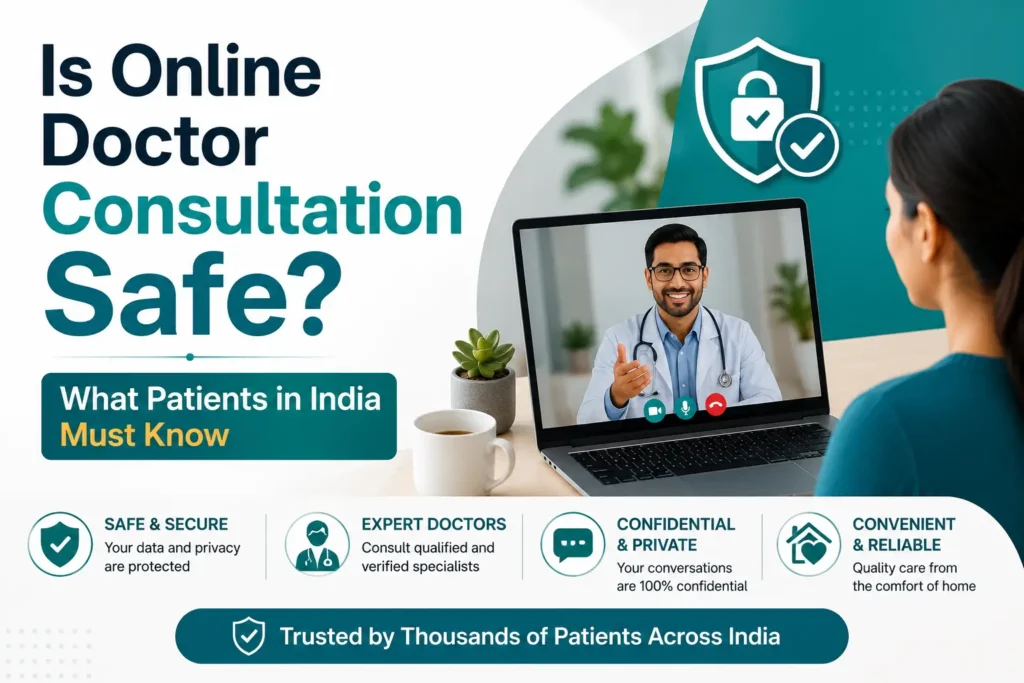
There’s a particular kind of hesitation that comes the first time someone suggests seeing a doctor through a screen. Maybe your daughter booked it for your nagging cough. Maybe you found the option yourself at 11 pm, unwilling to wait for a clinic to open. And right at the moment of tapping “confirm,” the doubts arrive: Is this a real doctor? What happens to everything I tell them? If this goes wrong, who do I even hold responsible?
Those questions aren’t a sign of being behind the times. They’re exactly the right questions to ask about your own health and privacy, and they deserve real answers, not a shrug and a “don’t worry, it’s fine.”
So here’s the honest, direct answer: yes, online doctor consultation is safe and fully legal in India, as long as you use a legitimate platform. It’s governed by two binding legal frameworks: the Telemedicine Practice Guidelines 2020, which regulate how doctors may consult you remotely, and the Digital Personal Data Protection Act 2023 with its 2025 Rules, which give you enforceable legal rights over your health data.
The catch is in that one phrase: a legitimate platform. This guide shows you exactly how to tell a safe service from a risky one, what the law protects, what it honestly can’t, and where online consultation is genuinely the wrong choice. Because “is it safe?” deserves more than a yes. It deserves the full picture.
Why does online doctor consultation matter in India and is online doctor consultation safe?
Before the safety detail, it helps to understand why teleconsultation grew so fast here in the first place. India’s doctors are heavily concentrated in cities: research based on National Sample Survey data found that 77.4% of India’s qualified health workers are located in urban areas, even though only about 31% of the population lives there.
For the two-thirds of Indians living in rural areas, including most of Assam outside Guwahati city, that imbalance means specialist care can be a day’s travel away. Online consultation exists precisely to help close that gap, letting a doctor in a city consult a patient in a district town who could never make the journey easily. That’s the promise. Safety is what makes the promise trustworthy.
Myths vs Facts
1. How do I know this is even a real doctor?
Most common among: first-time users of every age.
Legally, only doctors registered with the National Medical Commission (NMC) or a State Medical Council may consult online; and they must display their registration number in every communication with you, including prescriptions. If you can’t see a registration number, you’re not looking at a compliant service. You can verify any number on the National Medical Commission’s public register.
2. What happens to everything I tell them? Could my medical history end up somewhere?
Most common among: middle-aged professionals and privacy-conscious patients.
This is the fear that research shows is powerful enough on its own to stop people from using telemedicine at all. Since the DPDP Act 2023 and its 2025 Rules, telemedicine platforms are legally classified as data fiduciaries: your consent must be explicit, you can demand access or removal of your data, and breaches must be reported within 72 hours. This isn’t a promise in a privacy policy; it’s a statutory obligation with real penalties.
3. My mother can barely use WhatsApp. How is she supposed to do this?
Most common among: adult children arranging care for elderly parents.
Completely valid; and it’s exactly why the format matters. Research on older adults identifies “technology anxiety,” the fear of making a mistake or causing harm through improper use, as a major barrier. The practical answer is that phone-call consultations require no app skills at all, and a family member can join or manage the call. Where even that isn’t workable, a home visit remains the right choice.
Read More: How to Book a Home Visit Doctor in Guwahati; and What to Expect
4. How can a doctor tell what’s wrong without touching me?
Most common among: older patients accustomed to physical examination.
For a large share of everyday conditions, careful questioning and visual observation genuinely are enough; that’s standard clinical practice, not a shortcut. But this instinct is also partly right, and the Guidelines respect it: doctors are legally required to refer you for an in-person examination when your condition needs one. A doctor who says “you need to be examined” is following the law.
5. I’ll forget what to say, or won’t explain it properly.
Most common among: elderly patients and first-timers.
Also well documented; studies find older adults often struggle to articulate symptoms in digital consultations, partly because face-to-face visits allow nonverbal cues that a screen flattens. The fix is preparation: a written note of your symptoms, how long they’ve lasted, and what makes them better or worse. On a guided service, your Health Counselor captures this before the call so the doctor already has it.
Read More: How to Consult a Doctor Online: A Simple Step-by-Step Guide for First-Timers
6. If something goes wrong, who’s responsible?
Most common among: cautious patients of every generation.
The same person as in a clinic: the treating doctor. The guidelines are explicit that identical professional, ethical, and standard-of-care obligations apply to teleconsultation as to in-person care. Telemedicine is not a lower tier of medicine with lower accountability, and misconduct is reportable to the same medical authorities.
None of these fears deserve dismissal. Every one of them has a real answer; and the sections below explain the legal machinery behind those answers.
Is online doctor consultation legal in India?
Yes; and it has been, definitively, since March 2020.
Before then, teleconsultation existed in a legal grey area. Doctors had been offering it since around 2000, but with no statutory basis, its legality was genuinely unclear. That changed on 25 March 2020, when the Ministry of Health and Family Welfare published the Telemedicine Practice Guidelines, now part of Appendix 5 of the Indian Medical Council (Professional Conduct, Etiquette and Ethics) Regulations.
What the guidelines say for you as a patient:
- Only Registered Medical Practitioners can consult online: A doctor must be enrolled in the State Medical Register or the Indian Medical Register. No exceptions.
- Your first consultation can be online: You do not need a prior in-person visit, and doctors can consult patients located in any state.
- The same professional and ethical standards apply: As in a physical clinic. Telemedicine is not a lower tier of medicine; the duty of care is identical.
- Doctors must display their registration number in every communication with you: Prescriptions, messages, fee receipts.
A legitimate online doctor’s registration number should be visible without you having to ask. This is a simple safety check.
Your data is now protected by law:
This is the part almost no one writing about telemedicine safety has caught up with; and it’s arguably the biggest change for patients since 2020.
Under the Digital Personal Data Protection Act 2023 and the DPDP Rules 2025, every hospital, clinic, diagnostic lab, and telemedicine platform in India is now formally classified as a “data fiduciary.” In plain language: protecting your health information is a binding legal obligation, not a courtesy.
What this gives you, specifically:
Explicit consent is mandatory: Blanket or implied consent is no longer valid. Consent notices must be standalone, written in plain language, and clearly state what data is collected, why, and how it will be used.
You have the right to access, correct, and erase your health data: Platforms must be built so you can actually exercise this.
Your data cannot be used for anything beyond your care without permission: Only data necessary for treatment or research may be processed; secondary use without consent is prohibited.
Breaches must be reported within 72 hours: Platforms must also appoint Data Protection Officers and conduct impact assessments for high-risk activities.
Penalties are severe: Non-compliance is not a slap on the wrist; it carries substantial financial consequences, which is precisely why serious platforms now invest heavily in encryption, access controls, and data governance.
So when you ask “what happens to my medical information?” the honest 2026 answer is that Indian law now gives you more control over your health data than at any point in the country’s history.
Is an e-prescription from an online consultation valid?
Yes. A prescription issued by a Registered Medical Practitioner through a legitimate teleconsultation is legally valid across India and accepted at pharmacies, both physical and online, as well as for booking lab tests.
A valid e-prescription must include:
- The doctor’s full name and qualification
- Their medical registration number
- Date of issue
- Medicine name, dosage, and duration
- The platform’s details and a digital signature
If a prescription arrives without a registration number, that is a red flag; not a formatting oversight.
What online consultation cannot do?
- Doctors cannot prescribe certain medicines online: Schedule X medicines and narcotic substances are prohibited via teleconsultation under Indian drug laws; no legitimate doctor will offer them.
- Conditions requiring physical examination must be referred: The doctor is legally required to exercise judgement and direct you to an in-person consultation when your case demands it. A doctor who says “you need to be examined” is following the law, not avoiding work.
- Emergencies are not for teleconsultation: Chest pain, breathing difficulty, serious injury, unconsciousness, convulsions; these need emergency care immediately.
- Minors require guardian involvement: Patients under 18 cannot be consulted without parental or guardian consent.
Read More: Home Visit vs Online Consultation: Which One Does Your Situation Need?
Online vs offline consultation: Which is better?
| Factor | Online consultation | Offline / physical consultation |
| Physical examination | Not possible; visual observation only | Full examination: vitals, palpation, auscultation |
| Waiting time | Minutes; same-day availability common | Often hours in OPD; specialist appointments can take weeks |
| Travel required | None | Full journey, often a half or full day from districts |
| Total real cost | Consultation fee only | Fee + travel + lost wages (travel and lost income can account for roughly two-thirds of a visit’s true cost) |
| Availability after hours | Available late evening and at night on most platforms | Limited to clinic hours; after-hours means emergency room |
| Suitable for emergencies | No ; emergencies need immediate in-person care | Yes ; the only appropriate option |
| Diagnostic tests on site | Must be booked separately | Often available in the same facility |
| Prescription validity | Legally valid e-prescription | Legally valid written prescription |
| Privacy for sensitive concerns | High; consult from your own space | Lower; shared waiting rooms, familiar faces |
| Suitability for elderly/immobile patients | Good via phone call; may need family assistance | Difficult; travel and queues are physically demanding |
| Follow-ups and chronic care | Excellent; quick reviews without repeat travel | Effective but costly and time-consuming to repeat |
| Infection exposure risk | None | Present; waiting rooms concentrate unwell patients |
| Legal framework | Telemedicine Practice Guidelines 2020 + DPDP Act 2023 | Standard medical practice regulations |
How to Check if an Online Doctor Consultation is Safe: A Quick 2-Minute Checklist
| What to Look For | How to Check It | Is it Safe? |
| 1. Doctor’s License Number | Look at the doctor’s profile. A real doctor in India must show their National Medical Commission (NMC) registration number. If you can’t see a clear license number on their site or prescription, do not book. | [ ] |
| 2. Safe Website Address | Check the top bar of your browser. Look for a small closed padlock icon next to the website name. It means your private health details are locked and safe from hackers. | [ ] |
| 3. Proper Consultation First | Make sure a real talk happens. A genuine doctor will always talk to you on video or phone before giving a prescription. Any site promising “instant prescriptions without talking to a doctor” is fake and dangerous. | [ ] |
| 4. Easy Identification | Look for an OTP or phone sign-in. Safe platforms ask you to confirm your phone number so your medical history isn’t seen by strangers. If a site lets anyone in without checking who they are, leave. | [ ] |
| 5. Honest App Source | Only download from official stores. Never click random health links sent over WhatsApp or SMS. Always type the website name yourself or download the app directly from the Google Play Store or Apple App Store. | [ ] |
Remember: If a platform ticks all five boxes, you are on safe ground. If even one thing feels off or shady, close the page; your health and privacy are worth taking those extra two minutes.
Are you consulting with the right doctor?
To understand if you are with the right doctor or not? Here is how to tell if you’re in good hands, when to step back, and how to get it right from day one.
- Active listening: They give you the space to explain how you actually feel, rather than cutting you off after two sentences to start typing a prescription.
- They speak your language, not medical jargon: They explain your diagnosis, treatment plan, and next steps in plain, simple terms, making sure you understand why a medicine or test is being recommended.
- Their expertise matches your exact problem: A skilled General Physician knows when to treat a broad condition themselves, and when it’s clinically necessary to refer you to a targeted specialist (like a Cardiologist or Dermatologist).
Red Flags to watch for:
- You feel dismissed or rushed: If asking questions makes you feel like an inconvenience, or if your concerns are brushed off as “nothing to worry about” without proper reasoning.
- No progress and no clear answers: You’ve had multiple visits, taken tests, or finished courses of medication, yet your symptoms haven’t improved, and nobody has explained why.
- You’re seeing the wrong specialist: Going straight to a high-level specialist for general symptoms, or staying with a General Physician for a complex condition that needs specialized care, can lead to misdiagnosis and wasted time.
How We Take the Guesswork Out for You
Did you know? Many patients lose critical weeks simply because they self-diagnosed and booked the wrong specialist.
At Uzuhealth, you don’t have to guess who you need to see. Before you ever book an appointment, your personal Health Counselor listens to your symptoms, understands your complete history, and guides you to the exact right doctor, whether that’s an experienced General Physician or a dedicated specialist.
Read More: General Physician vs Specialist: When Do You Actually Need a Specialist?
In The End
If you’ve read this far, notice what’s happened to the question you started with. “Is online consultation safe?” turns out to have a clear, evidence-backed answer: it’s legal, the Telemedicine Practice Guidelines regulate it, the DPDP Act protects your data, e-prescriptions are valid, and a two-minute check tells you whether any platform can be trusted. The fear you began with was reasonable, and every part of it now has a real answer.
But there’s one thing no regulation can do for you. The law can verify a doctor’s license; it can’t sit with you at 10 pm and help you work out which doctor you actually need. It can protect your data; it can’t explain your diagnosis in words that finally make sense, or check in a week later to see whether you’re getting better.
That’s the part Uzuhealth built its service around: verified doctors and secure consultations, yes, but also a Health Counselor who stays with you from your first message through to recovery. Because genuinely safe care isn’t only legal care. It’s guided care — the kind where nobody in your family has to face a health worry alone.
→ Book a safe online consultation with Uzuhealth
1. Is online doctor consultation safe in India?
Yes, online consultation is legally regulated under the Telemedicine Practice Guidelines 2020, which require that only Registered Medical Practitioners consult remotely, and the DPDP Act 2023 with its updated 2025 Rules, which legally protect your health data. Safety depends on using a legitimate platform that displays doctor registration numbers and follows consent requirements.
2. Is online doctor consultation legal in India?
Yes, definitely since 25 March 2020, when the Ministry of Health and Family Welfare published the Telemedicine Practice Guidelines. These are now part of the Indian Medical Council (Professional Conduct, Etiquette and Ethics) Regulations.
3. Is an online prescription valid in India?
Yes, e-prescriptions issued by Registered Medical Practitioners through legitimate teleconsultations are legally valid and accepted at all pharmacies and labs. A valid e-prescription must display the doctor’s name, qualification, registration number, date, dosage details, and digital signature.
4. What can’t be prescribed through an online consultation?
Schedule X drugs and narcotic substances cannot be prescribed via teleconsultation under Indian drug laws. Doctors are also legally required to refer you for in-person care when your condition requires physical examination and the need for these medicines.
5. Can a doctor diagnose me correctly without a physical examination?
For many common conditions, yes; doctors are trained to assess a great deal through detailed questioning and, in video consultations, visual observation. The guidelines require doctors to recommend an in-person consultation whenever a physical examination is genuinely necessary.
6. How do I know if a telemedicine platform is legitimate?
Check five things: visible doctor registration numbers, an explicit consent process, a findable privacy policy, transparent fees before booking, and properly formatted prescriptions. Any platform issuing prescriptions without an actual consultation is operating illegally.
7. Can children consult a doctor online in India?
Patients under 18 cannot be consulted online without parental or guardian consent and involvement, as required under the Telemedicine Practice Guidelines.
Disclaimer: This article is for general informational purposes only and is not a substitute for professional medical advice, diagnosis, or treatment. Always consult a qualified healthcare provider for any medical concern.